Martin Scorsese is one of the best directors who ever lived, and I think that Christopher Nolan is on his way to earning that distinction. In the last week I've watched the few remaining movies by both of them available for streaming on Netflix.
The Age of Innocence

Love stories are often passionate, but few let that passion boil just under the surface as much as it does in The Age of Innocence. Daniel Day-Lewis plays a lawyer from a wealthy family in 1870s New York City (only a few years after the chaos and violence depicted in Scorsese's other film Gangs of New York) who becomes engaged to a woman played by Winona Ryder, but when her cousin played by Michelle Pfeiffer returns from Europe, he realizes how much stronger his feelings are for her instead. Wealthy families always want to avoid scandal though, and Pfeiffer is already damaged goods since she's considering divorce from her powerful husband, and they struggle with whether to take a chance or avoid causing a stir. Innocence is a well made movie with really good lead performances, but because it's so wrapped up in that distant old wealthy people mode, I didn't really find it gripping for most of its duration. A good movie, but I didn't find myself very invested.
Boxcar Bertha

Boxcar Bertha was Scorsese's first film that wasn't connected to his student projects, and it took a while for me to figure out what was off about it. Eventually though, it hit me - it's an exploitation movie. Not a terrible one, and it's one based on unusual concepts for that sort of thing, but it's still an exploitation movie. It uses issues like labor unions and race relations to make a movie about a girl who gets naked sometimes and robs banks and shoots people with her partners. It's sort of a second-rate Bonnie and Clyde with worse acting. I don't want to be too harsh on the movie, because it does some interesting things that most B movies you'd compare it too wouldn't. But it still never reaches very high, so even its solid execution results in a movie that's decent at best.
Following

Following is Nolan's first film, shot independently in black and white on a very small budget. It concerns an unemployed aspiring writer who decided to start following random people to learn about them and get inspired. Eventually he repeatedly follows the wrong guy, and gets pulled into a world of small-time burglary and betrayal. Much like his next film Memento, Following has a complex plot that is further complicated by the script's non-linear approach to structure. It jumps back and forth between time periods, always revealing things that end up clarifying or contradicting what came before. The actual truth behind what's going on when it's finally revealed can be looked at in two ways. On one hand, it's really kind of an absurdly complicated scheme to resolve what wasn't that difficult of an issue, and it's sort of unlikely that the whole thing would come together correctly. But on the other hand, it's still a really fun mystery to unravel, and the fun of noir movies is always that moment of realization when it all finally makes sense. It's a really good first effort.
Insomnia

Insomnia is the only film Nolan's directed that wasn't based on his own screenplay, and it shows a bit. He was proving to studios that he could handle a larger budget and more recognizable cast, and he does a good job of that, though the movie underneath is merely solid and definitely the least interesting thing that he's done. It's pretty much a boilerplate detective story with a plot that wouldn't be out of place in a random episode of most cop shows, but there are a few things that make it work. The first act twist that provides Al Pacino's Detective Dormer with an internal conflict does a good job of complicating an otherwise standard plot, and the ensuing insomnia that plagues him adds a lot of flavor to the whole movie. The acting by him and Robin Williams is good, and it's a really well-shot film, particularly in a few really tense sequences that are unlike what you'd usually see in this type of story. Hilary Swank's character seemed really badly written, and there are a few other hiccups, but mostly it's an above average Hollywood mystery/thriller. Nolan's best asset is probably his screenwriting, but I think with Insomnia he shows it's not the only thing he can do.
The Last Temptation of Christ

Based on a book besides The Bible, The Last Temptation of Christ tells the story of Jesus Christ in a very different way than we're used to. Willem Dafoe's Jesus is tormented by his knowledge and his communications with God, and he is a much weaker man than he is ever depicted as being in the New Testament. The movie hits a lot of the expected notes from the few years that he worked as a prophet, from his wandering in the desert to his sermon on the mount to turning water into wine to the healing of the sick and of course, his arrest and crucifixion. But it shows these moments in different ways than we're used to, and considering these stories in a different light, seeing them as the actions of a man with weaknesses and desires that he must sacrifice rather than an all-knowing and serene son of God is very interesting. The most memorable and controversial sequence comes near the end, when we see Jesus as a man who raised his own family rather than one who died for our sins, but the resolution of this sequence, when everything finally comes together, is extremely powerful, and strikes me as something that would restore faith rather than challenge it. Definitely one of the best religious movies I've ever seen.
Sunday, December 18, 2011
Movie Update 32: Nolan and Scorsese
Monday, October 31, 2011
Gangs of New York

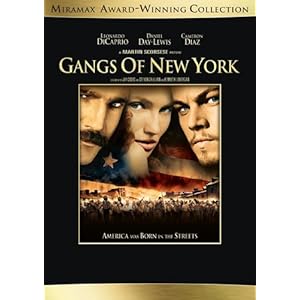
I'll be honest, I usually find historical epics to be pretty boring. Even the good ones could use some trimming. Leave it to Martin Scorsese though to create one that's gripping from the first second of its nearly three hour running time to the last. It tells the story of New York City before it became the mecca of human civilization it is today, when the streets still ran red with the blood of the many warring factions that vied for influence and their many victims. The film isn't a true story, but besides some embellishments it may as well have been. It stars Leonardo DiCaprio in his first of four collaborations with Scorsese as the son of an Irish immigrant and leader of the Dead Rabbits, and Daniel Day-Lewis as Bill the Butcher, the man who killed him. It starts with a war between two gangs for control of Five Points, a district in the city where the poor make do. The extremely bloody battle sets the tone for the rest of the film, establishing its main characters and their later motivations, as the plot quickly jumps forward to when DiCaprio's character has grown up.
The two best things about the movie are easily Scorsese's direction combined with the amazing work done to recreate 1800s New York and capture it on film, and Day-Lewis' performance. You could pretty much cut the protagonist out of the film and it could just be a great story about a leader of both crime and community in a city as it slowly develops into something resembling modern society. That's not really to slight DiCaprio, that's just how good Day-Lewis is. There's just something cool about the place the film creates, filled with hard men with curly mustaches, top hats, and razors and knives tucked into their clothing. And he epitomizes it with his glass eye and inscrutable nature. You never know if he's going to cut your throat or give you a pat on the shoulder. DiCaprio has his romantic foil, played by Cameron Diaz, can't quite measure up to his work, though they're perfectly fine otherwise.
The supporting cast is fantastic too, featuring recognizable faces in a variety of roles, supporting various sides as they see fit. Liam Neeson brings plenty of gravitas to the couple scenes in the beginning where he plays DiCaprio's father, which lends weight to later scenes where Bill shows clear ongoing respect for his former foe. The small time crew DiCaprio runs with features Al Capone from Boardwalk Empire and D'Angelo from The Wire, and Brendan Gleeson and John C. Reilly give interesting performances as former allies of Neeson who may no longer agree with his ideas. The film isn't without problems, of course. The entire third act is pretty messy, as though the screenwriters lost momentum and had to basically force things to make sure they managed to check off all the plot details they needed to to reach their conclusion. And that conclusion, while thematically appropriate, does result in a rather unfortunate anticlimax of an ending. With Scorsese at the helm though, all of those individual scenes manage to be good if not great, and he makes the problematic ending work because it's very clear what they're going for. He just knows how to make great movies, and this is certainly one of them.
Friday, January 22, 2010
Characters of the Decade: Part 4
One more to go after this one. Man, this really is TV heavy, isn't it?
Haruhi Suzumiya
Aya Hirano - The Melancholy of Haruhi Suzumiya
"Feelings of love are just a temporary lapse in judgment. Like a mental illness."
I might actually like mild-mannered narrator Kyon more, but the show's about Haruhi, and unlike the vast majority of characters, the universe really does revolve around her. She has a unique, eccentric personality that can make almost anything fun to watch, and is the sort of leader whose followers always wonder why they do what she says but do anyway. And there are enough glimpses at her normal, affectionate side in between world threatening crises that she's inadvertently responsible for that she comes through as a person and not just a cipher for the writers' wacky ideas. I guess I like that kind of character a lot, don't I?
Dexter Morgan
Michael C. Hall - Dexter
"Harry and Dorris Morgan did a wonderful job raising me. But they're both dead now. I didn't kill them. Honest."
In a lot of ways, Dexter is a flawed show. It's frequently predictable and there's way too much time spent on supporting characters and subplots we never actually care about. It's easy to keep watching though, because Hall's work is so good. I admit to being a little tired of his dry narrating style at this point but he can still carry the series through any low points. Until very recently he's been one of the best actors I can think of who only works in television, but he's really damn good at it, finally getting recognized by the Golden globes recently (although that award's tainted because Bryan Cranston wasn't even nominated), and is why I gave Six Feet Under a shot, which turned out to be a good decision. He somehow finds a way to sell the sympathetic serial killer angle, and still be menacing when required. All you could ask for from a lead.
Dr. Steve Brule
John C. Reilly - Tim and Eric Awesome Show, Great Job!
"For your health!"
Reilly is supposedly a very good serious actor, although all I've ever seen from him is his brilliant comedy work. His best role is most pathetic, as the befuddled and under-qualified local news correspondent Dr. Steve Brule. He's good for a few appearances per season, and they're routinely pure gold. In addition to his terrible advice and wacky outtakes, there are a lot of things about the character that make him endearing in a sad way like his chronic loneliness and crush on married news anchor Jan Skylar. He's getting his own show soon, and I can't see how it won't be fantastic.
Juno MacGuff
Ellen Page - Juno
"Nah... I mean, I'm already pregnant, so what other kind of shenanigans could I get into?"
Juno's a really divisive movie. Some appreciate its uniquely goofy dialogue and moments of indie cuteness, while others can't stand it. I'm with the former, and a big part of why the movie works for me is Juno herself. She has a unique vocabulary for a teenager, but I'm not selective on what I allow films to be fanciful about, and she really sells the whole teenage girl with problems thing that I usually can't stomach for very long. In a movie I saw for Jason Bateman and Michael Cera, Ellen Page is the one who impressed me most.
Leon Black
J.B. Smoove - Curb Your Enthusiasm
"Barack Obama! I'm the President of hitting that ass!"
Probably the least scripted character on this list. In a show where everybody just says what comes to mind during the scene, Leon takes it to the extreme. He can make any topic funnier than should be possible, from the proper way to respond to an insult to the appropriate amount of discretion required when discussing a friend's wife whose ass you're hitting. I enjoyed seeing Smoove pop up in an episode of Castle and hope to see him get more opportunities, but to me he'll always be Leon.
Emerson Cod
Chi McBride - Pushing Daisies
"Bitch, I was in proximity!"
After watching the rather bad previews for Human Target, I almost decided to give it a shot. That's how much I like the whole cast of Pushing Daisies, and I liked Emerson most of all. While the show lived off its saccharine sweetness, Cod was the bitter one who kept it from floating off into space. He's a perfect foil for pretty much everyone else, and his combination of intuition, wit, and resourcefulness made each case into a classic film noir. The show made strides to humanize him during its short run with love interests and a missing daughter, but it probably didn't need to. He's the kind of guy who'd be a pleasure to watch visit the DMV.
GLaDOS
Ellen McLain - Portal
"That thing you burned up isn't important to me. It's the fluid catalytic cracking unit. It made shoes for orphans. Nice job breaking it, hero."
Portal was already a unique and brilliant mind-bending puzzle game, but GLaDOS made it something that every gamer should try. Just one of the funniest and best executed character arcs in the medium. Encouraging at first, the artificial intelligence guiding you through a test facility you never quite understand slowly becomes more sinister over time, and downright hostile after a certain point. But she never loses her sense of humor, logging one of the best percentages of successful one liners in history (I just made that up, but it sounds right). Plus the song at the end is just icing on the cake. I just made myself groan.
Anton Chigurh
Javier Bardem - No Country for Old Men
"Would you hold still please, sir?"
It's rare to see such an intimidating force of nature in a film. Compared to the other people in the story, Chigurh is almost a caricature, a flesh and blood Terminator that will stop at nothing to accomplish his task. He also sort of rips off Two-Face's gimmick, although he pulls it off better. It's sort of his lack of humanity that makes him work though, taking the movie from being a solid, off-beat thriller and making it into a pretty impressive, unique work that stands alone. I'm not sure if it's exactly a brilliant performance, but it's certainly exactly what it needed to be.
Nathan Drake
Nolan North - Uncharted series
"I didn't think that far ahead!"
As video game protagonists were getting too grim and gritty, Nate came along and reminded people that heroes are allowed to be likable. Sure, his carefree attitude doesn't quite work with his near-genocidal kill count after only two games, but work with me here. It's shifted the tone of a lot of modern action games, and there's been so much demand for North's voice work that the Internet backlash is already well underway. It's clear from some of his roles that he has a good deal of range, but his classic sarcastic good guy voice is what people want, and I'll forever associate it with the first and still most interesting character I heard it from, Mr. Drake.
Daniel Plainview
Daniel Day-Lewis - There Will Be Blood
"One night I'm gonna come to you, inside of your house, wherever you're sleeping, and I'm gonna cut your throat."
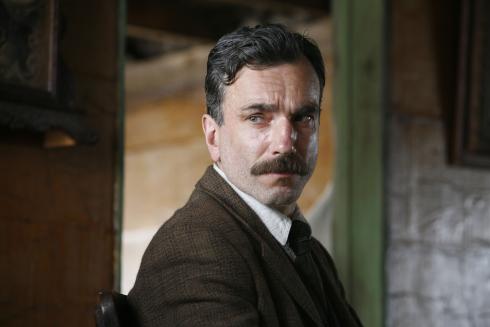
I think my favorite single adjective I've heard used to describe Day-Lewis' work in this film was when Quentin Tarantino called it "volcanic". It just fits, doesn't it? There's really not much I can say about it that hasn't been said better by people who have a deeper understanding of acting. I just know that I've never been more impressed while watching somebody in a film. From his silent actions in the very beginning, to his dark charisma as his business gets going, to his increasing madness as the film continues and to the final scene which is both funny and startling, there's not a moment that could have been obviously improved. I won't forget it any time soon.
Walter White
Bryan Cranston - Breaking Bad
"We are going to make a good product that does what it is supposed to, as advertised. No emulsifiers, no baking powder, no bleach, no chili powder."
Despite the Golden Globes' continued negligence (Seriously, Avatar's the movie of the year? Why did I even look up the results?), even the slightly less maligned Emmys managed to see what everyone else has the last couple years with Cranston's great work on Breaking Bad the last two years. Watching a man learn that he was dying, turn desperately to crime to help his family, go back and forth hope and despair, and ultimately lose sight of what's important in his life has been a really eye opening experience. We always knew Cranston could be funny, but I've been a lot more impressed by this. I can only wonder what Walter will do next.
Bryan Mills
Liam Neeson - Taken
"That is what happens when you sit behind a desk. You forget things, like the weight in the hand of a gun that's loaded and one that's not."
What should have been a simple revenge-driven action movie ended up being pretty brilliant thanks to to lead's increasing willingness to abandon reason or sympathy in his quest to get his daughter back. More movies should just put guns in the hands of respected veteran actors and see what happens, because it totally worked out here with Neeson. In some ways it's a bog standard thriller, it's just that extra 10% of gravitas and brutality that makes it one of my favorite films ever of the type. Why exactly did they sit on this for a year before releasing it in America?
Concluded tomorrow.
Tuesday, March 4, 2008
There Will Be Blood

When No Country for Old Men won the Oscar for Best Picture, I was happy for the Coen brothers, who have long been my favorite directors in Hollywood. Now that I've seen Paul Thomas Anderson's turn-of-the-century tale of oil and money however, I'm not sure the Academy made the right choice. The movie starts and ends with Daniel Day-Lewis' performance as Daniel Plainview. I hadn't seen any of his work before, and since he can't cross the street without tripping over an Oscar nomination, I was interested to see just how good he could be in his second winning turn. The movie begins pretty slowly, with no dialogue at all for more than ten minutes, just showing the beginnings of Daniel's drilling business. But the instant he started talking, I was immediately drawn in. It's really incredible how completely transformed he is, from his face to his voice to his mannerisms. If you've seen Day-Lewis in this and in real life, you'll know what I mean. He definitely deserved the awards.
His isn't the only good performance in the movie though. Paul Dano, recognizable as the big brother from Little Miss Sunshine, is also quite good as Eli Sunday, a preacher in the little town where most of the movie takes place. There are some really tremendous scenes between the two, including some sermons in the church and the pretty remarkable ending. I haven't seen any of Anderson's other movies, but his approach is quite interesting. There are lots of fairly long tracking shots, and there are a couple of instances where they allow some mud or oil to get on the lense without getting rid of it. The movie is quite long, and you get the sense he's just letting everything happen instead of making it into a tidy little production. Despite the length, there's not much I can say I would want to have cut. It's pretty enjoyable all the way through, if for nothing else than the great acting on display. It might be a little out there for some people, but I really liked it.