Showing posts with label classic. Show all posts

Sunday, February 26, 2012

Movie Update 40

Man, 40 of these stupid things. No witty comment, just: man.

Anatomy of a Murder
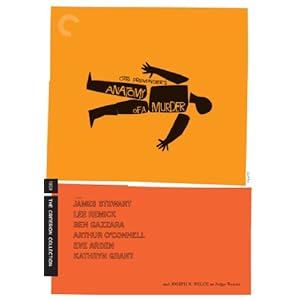

One of a pair of long courtroom dramas I saw this last week, and one of a pair of movies starring James Stewart. He plays an aging lawyer who despite being out of practice, agrees to defend a soldier who murdered a man after he supposedly raped his wife. Strictly, the rape wouldn't be enough to qualify the killing as self defense, but Stewart uses it as leverage to help push a plea of temporary insanity. The film examines how precarious the legal system is, requiring the jury to ignore information they have been given and having cases rely on the always unreliable human ability to lie or accurately remember what happened. There's some terrific acting, and it's interesting how the truth is not what's important, but rather the trial itself.

Harvey
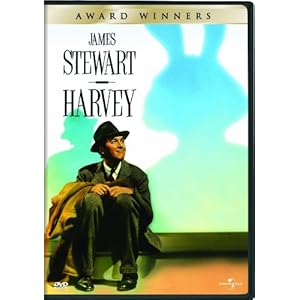

Another really good James Stewart performance, one that props up a movie that is watchable but I wasn't particularly drawn to. He plays a man with a friend named Harvey who happens to be an invisible six foot tall rabbit. Everyone thinks he's crazy, even his sister, who may or may not also be able to see Harvey. Various people act like assholes towards Stewart, but in the end things turn out okay because blah blah whatever.

Judgment at Nuremberg
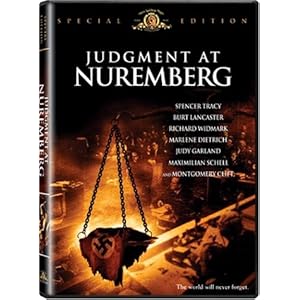

A movie about one of the infamous trials at Nuremberg, where four judges are put on trial for rulings they made during the Nazi rule of Germany. It's undeniable that they made decisions that contributed toward the horrible things that happened under the Nazis, but the defense makes a great case that they are no more culpable than other people who didn't actively work against the regime and even other governments that didn't stop them earlier. Maximilian Schell actually won an Oscar for his depiction of the defense attorney, and he was quite good, though personally I preferred the more subtle work of Spencer Tracy as the chief judge on the tribunal. It's important to be reminded sometimes of just how awful the Holocaust was.

Stripes
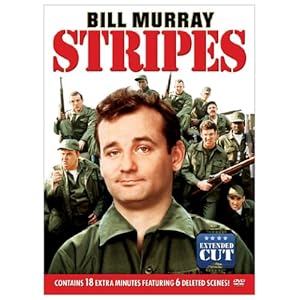

A pre-Ghostbusters Ivan Reitman/Bill Murray/Harold Ramis joint that substitutes cursing, nudity, and general silliness for true wit or an intriguing premise. There's something still likable about Bill Murray's dickishness, but I thought overall Stripes was pretty uninspired as a comedy, although that doesn't prevent it from being pretty watchable anyway. It has a fine cast, including John Candy and Judge Reinhold as two of the more recognizable supporting members. Really, there's nothing terrible about it, I was just hoping for more from its talented core.

Monday, February 6, 2012

Movie Update 38

Hey, how about I write a little bit about some movies I saw recently and then you can decide whether or not you agree with me.

Lethal Weapon 2


I have to admit I kind of miss movies like this - big summer blockbusters that don't rely on high concept science fiction to get their thrills. It's not that I don't like science fiction, obviously, I just miss action movies that aren't about superheroes or robots or vampires or whatever. Lethal Weapon 2 isn't even that spectacular - it's just a solid buddy cop movie with a enjoyable rapport among the main characters and some fun, bloody action scenes. But that's all it really had to be. I'm glad I watched it.

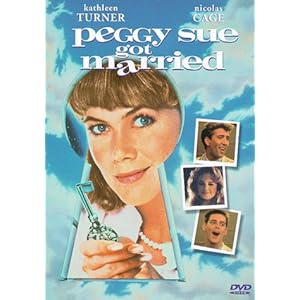
Peggy Sue Got Married


I don't know how many times I can keep saying that Francis Coppola had a strange career after the 70s, but it's still true. Back to the Future got the lasting attention, but Peggy Sue Got Married is another time traveling 80s high school comedy thing, starring Kathleen Turner as a woman who loses consciousness at her 25th high school reunion and wakes up as a 17 year old again, determined to make different choices and not even sure that any of it is actually real. The movie plays up the drama a fair bit and is less wacky than most movies of its sort, but its highlight is definitely Nicolas Cage, from his hair to his bizarre voice to his whole demeanor. Odd, but more fun than most of Coppola's other odd movies.

Shane


I believe this is the final film from AFI's revised version of the 100 best American movies that I've seen, and it's a pretty good one. Alan Ladd stars as the titular character, a gunman who tries settling down with some farmers out West, but finds he is unable to escape his past when they get increasingly harrassed by men who want control of the whole territory. There's an annoying kid who comes close to ruining the movie on a number of occasions, but it manages to survive as a classic example of a solid but not great 50s Western.

Speed


Another fine example of a blockbuster action movie that didn't need an impossible concept to work, although it does rely pretty heavily on a gimmick. I know I'm one of the last people to see this movie, and I don't need to tell you what it's about, but I will say the movie does a pretty good job of adhering to a traditional and workable story structure despite a great deal of it taking place on a speeding bus. There's very little in the way of real human on human violence, but due to the clever exploitation of the plot's strange circumstances and the chemistry of the main cast it remains exciting for most of its duration. I liked it more than I expected to in any case, and Keanu Reeves' bad acting is in fine form.

Sunday, January 29, 2012

Movie Update 37

You know what's up.

Crimewave


This is the only produced Coen brothers script that the brothers didn't direct themselves, though the duties were taken by their friend Sam Raimi. It combines elements of both of their careers in film, and combines them to create what might be best described as a live action Looney Tunes movie. The subject matter is darker, but the actual content of the film really isn't. When a man hires a couple of goons with silly voices to kill his business partner after finding out about his betrayal, they end up going on a rampage through the city, with one of the man's employees and a girl he meets getting caught up in it. It's a very strange and silly movie, with some very elaborate comedic setups, surprisingly exciting moments of action, and an entertaining appearance by Bruce Campbell. A bizarre film that you'll probably like if you're a fan of the filmmakers involved.

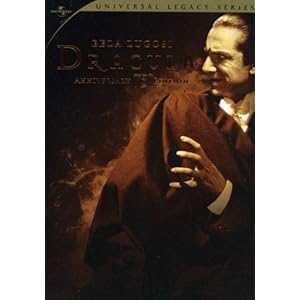
Dracula


It's always interesting to me how sterile and stately the horror films of the 20s and 30s are. Genre icon Bela Lugosi stars in his signature role, instilling Dracula with charm and menace as he moves from Transylvania to London in order suck a lot of blood. It's of course pretty toothless in comparison to modern vampire stories, but I mostly enjoyed the slow discovery by the other characters of what Dracula really is and their calm attempts to prevent him from killing or enslaving any more women. Heh, toothless.

One from the Heart


Post-70s Francis Ford Coppola continues to make absolutely no sense to me. One from the Heart tells the story of a couple in Las Vegas that finds their relationship falling apart, and their struggles to either resolve their differences and move on with their lives. What makes the movie different is its musical quality - the characters don't really sing, but the original music by Tom Waits pervades the whole thing, it frequently dabbles in an unreal sense of space, and the film is entirely and totally obviously filmed on elaborate sets at a soundstage. The movie's budget problems and failure at the box office cost Coppola a ton of money, and a lot of his career from then on can be attributed to continued financial problems. Was it worth it? Uh, not really. The movie is okay.

Witness for the Prosecution


A courtroom drama directed by Billy Wilder, based on a play, based on a story by Agatha Christie. Other actors get higher billing, but the star of the show is definitely Charles Laughton, an aging English lawyer who was recently released from the hospital and decides to take on the defense of a man accused of murder, against his doctors' wishes. The trial itself is pretty straightforward, until the characters start making unexpected choices and Laughton has to stay on his feet to deal with the changes and continue the defense to his best ability. The ending is so twisty that a voice actually advises the audience to avoid spoiling it to their friends so they can enjoy it too. It's a well-made and wonderfully acted legal drama that wraps up satisfyingly without letting anything come too easily.

Monday, January 16, 2012

Movie Update 36

These were expiring, so I watched them. Yep.

Ball of Fire


A screwball comedy directed by Howard Hawks, featuring Gary Cooper playing off type as an awkward, stuffy intellectual and Barbara Stanwyck playing very much on type as a club singer and mob boss' girlfriend who helps him and his fellow encyclopedia writers come out of their shells. Ball of Fire is mostly an enjoyable movie, though there's definitely something very weird about it. The professors are all pretty likable guys, but it's just a little uncomfortable seeing them all fawn over a young and attractive woman, even if it's innocent. The shift from her using them to avoid the police to actually getting romantically interested in Cooper is pretty abrupt as well. As I said though, it's mostly a fun movie.

Deathtrap


Sidney Lumet movies are often based on plays or feel like they could be, taking place in a small number of locations and not being particularly visually flashy. That's definitely the case with Deathtrap, though I think the entire thing being limited mostly to a single house works in its favor. Deathtrap was a play about writing a play based on a murder, and the fact that the movie version isn't a play itself does do a little to remove some of the inherent cleverness of the structure. But the story still works, and the performances by Michael Caine and Christopher Reeve are really good. I can't say as much about the other characters, but it's both an amusing and incredibly tense movie at times, with some great twists and surprises.

The Life and Death of Colonel Blimp


It was a big surprise for this movie to be in color, though apparently that was a thing for its makers Powell and Pressburger while most directors from the 40s were still working in black and white. The movie is based on British cartoons about a blowhard English military man, though it tells an original story about how such a man might come to be like that over a lifetime of fighting in wars. Roger Livesey and Anton Walbrook give a pair of great performances, first as young soldiers, then as middle aged veterans of the first World War, then as old relics at the beginning of the second. There's also an amusing bit with Deborah Kerr playing three different women who all look the same at various points in his life. The movie is concerned with many things, but the main one I thook away from it is how a lifetime of experiences can affect a person and make them who they are. A great and refreshingly civil war movie.

Odd Man Out


Carol Reed's The Third Man is a classic of the noir genre, though I can't say I enjoyed Odd Man Out nearly as much. It has an interesting subject, with James Mason playing an IRA leader who gets wounded and stranded in the middle of Belfast (though the film is not actually explicit about either of those references). There are some interesting moments sprinkled throughout, though I was mostly kind of bored while I was watching it, which shouldn't happen with a movie about hiding from the police and troublesome politics. I didn't think it was bad, I was just rarely actively intrigued by what was happening, and with a genre that thrives on intrigue, it was disappointing.

Wednesday, January 4, 2012

Movie Update 35

Here are a few movies I saw before the end of the year. I won't keep you in suspense: I liked them all.

Dreams


One of Akira Kurosawa's last films, Dreams is more like a collection of shorts, all based on various dreams he had and presented in very different ways. You can detect some progression as it goes on, as the early segments feature children as the central characters, while later ones are generally darker, and the last few all star the same person. But mostly it's just disjointed ideas brought to life in usually interesting ways. I liked the movie more than I thought it would, from its bizarre fantasy imagery to its more unsettling moments. I've never felt more cold watching a movie than I did watching the blizzard segment. It also features Martin Scorsese in a cameo as Vincent van Gogh, which is weird.

The Limey


I kind of like the idea of Steven Soderbergh, but I haven't actually really, really enjoyed a movie he's made until now. The Limey is an extremely sharp and tight revenge thriller starring Terence Stamp as an older British career criminal who takes a trip to America after getting out of jail to get even with the man responsible for his daughter's death. There's really no nonsense about the movie, it's pretty short and has very few characters who aren't directly related to the single central story thread. It's not the most exciting movie ever, but it's occasionally quite tense and sometimes even pretty funny. It also has a lot of nice little touches, like Soderbergh inserting snippets of a much younger Stamp from another movie to establish his backstory. The whole thing is very minimal and hazy, with its frequently jumping around in time in moments of reflection. Not quite great, but a very good take on some pretty basic material.

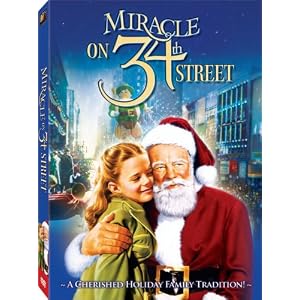
Miracle on 34th Street


I've seen pieces of this movie before, but the part that I didn't know, and what I think is totally brilliant about it, is that it never answers the question of whether the "Santa Claus" in this movie is actually Santa Claus. It doesn't answer the question because the answer doesn't matter, what matters is the message he's trying to give to the people around him. Well, I thought it was clever, anyway. Otherwise, it's a charming old Hollywood movie with charming old Hollywood acting, and it's sort of interesting seeing Natalie Wood this young even if her character is pretty annoying. A really nice family holiday movie, that nicely skirts a lot of issues with that subgenre.

Running on Empty


Sidney Lumet's Running on Empty is an odd little movie, combining elements of crime and soap opera. The story begins years before the film itself starts, when a couple decides to bomb a laboratory owned by a company that made napalm, and accidentally severely injures a janitor that wasn't supposed to be there and goes on the run. Years later, they're still on the run, changing identities and moving every time they suspect the law might be on their trail, with two kids in tow. They're pretty used to it, but the older son, played by River Phoenix, is getting a bit old to be staying with them, almost ready to graduate high school. Things really change when he both meets a music teacher who's impressed by his piano skills and wants him to go to college for it, and falls in love with the teacher's daughter. Family drama ensues. It's the kind of thing that probably shouldn't have worked, but Lumet is a director who seems to be able to do a lot with some slim material. It's far from his best movie, but it's a pretty good one with some strong emotional moments.

Sunday, January 1, 2012

Movie Update 34: Alfred Hitchcock

A bit of the master's earlier British work, a movie from his golden age, and the last one he ever did.

The 39 Steps


I think this is considered one of Hitchcock's better early films, but I thought it was merely pretty good. A man gets involved in a spy conspiracy after a woman asks him for help, and he has to uncover the secret of what the 39 steps are before he gets captured or worse by the people behind it. The main character runs around a lot but the way the mystery gets solved is kind of silly and there really isn't much to the movie besides him running away. North by Northwest is pretty similar, but I think it was done much better.

Dial M for Murder


I think Hitchock was definitely at his best in the 50s, and Dial M is another feather in his cap. It actually came out the same year as Rear Window, but while it's not as good as that movie, it's still a solid thriller, and one that similarly takes place almost entirely in a single location. A man tries to put the finishing touches on a very elaborate scheme to murder his cheating wife, but of course the plan goes wrong and he desperately tries to cover his tracks while the police sniff around his apartment. It's a very cerebral film, and it's very easy at a number of points to go "wait, what?" as the little tricks and traps the characters place for each other start going off constantly. It comes together very well by the end, though.

Family Plot


Sort of an odd note for Hitchcock to go out on, Family Plot is half mystery and half sort of weird comedic thing. Certain bits that you wouldn't expect to be played for laughs are, but other moments are pretty dark. It stars a psychic and a cab driver/investigator who get a lucrative job to find an old woman's long lost relative, who turns out to be a murderous jewel thief. Espionage and hijinks ensue. Family Plot is not a bad movie at all, but it's definitely an unusual way for one of the best filmmakers ever to end his career.

Sabotage


A woman begins to suspect that her husband is a terrorist, but not before a lot of bad stuff happens to her. There are a couple nicely tense moments, but ultimately the only thing I'll probably remember about it is that it's the origin of the old clip from Inglourious Basterds in the scene where the narrator explains the combustible properties of nitrate film. It's quite short, and simply put, not much at all happens.

Saturday, December 3, 2011

Movie Update 31

Crank: High Voltage


Remember when I said that the original Crank was actually less over the top and insane than it advertised itself as? This sequel, which brings back most of the significant characters in some way and attempts to escalate on everything the first movie did, corrects that issue. Instead of having to keep his heart rate up by doing things like getting into fights and having sex with Amy Smart, Jason Statham's heart has been replaced with an artificial one and he must keep its battery charged by doing things like electrocuting himself and having sex with Amy Smart (because it generates static electricity through friction, obviously). There's a lot more violence and nudity and general zaniness in this movie, so it succeeds at surpassing the first movie in that way. It does have a different problem though, which again prevented me from really liking the movie - it just seemed too mean-spirited. People don't just get hit in the nuts, their genitals get destroyed. A man is forced to punish himself for messing up by graphically cutting off his own nipples. Just lots of messed up stuff like that, and I thought it was usually more gross than entertaining. Otherwise, it's as kinetic and crazy as advertised, with a few moments of inspired originality.

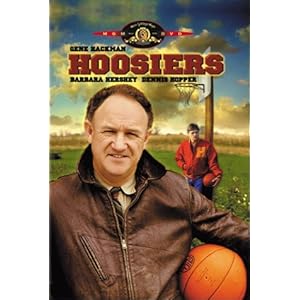
Hoosiers


Hoosiers is as predictable an underdog sports story as you're ever likely to encounter. Gene Hackman comes to a small Indiana town to become the high school basketball coach, and he struggles to gain the acceptance of the locals before molding the team into an unlikely winner, more successful than they've ever been before. Dennis Hopper plays the father of one of the players, a drunk and embarrassment to the town who actually knows a lot about the sport. Barbara Hershey is a teacher at the school who questions Hackman's methods but eventually warms up to him. There's a kid who's supremely talented but unwilling to play, and a bunch of ignoramuses who have it out for the interloper. Though it's nothing you haven't seen a bunch of times, Hoosiers is still a charming and well-executed version of that formula. The acting is solid, and the basketball scenes are authentic and exciting. It was a bit weird for the only black people in the movie to appear at the end as players for the big bad final opponent (the movie takes place in the 50s), but otherwise there's not much to really hold against the movie. Pretty likable stuff.

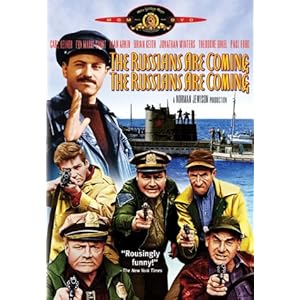
The Russians Are Coming, the Russians Are Coming


A weird mix of comedy and politics, The Russians Are Coming tells the story of a Soviet submarine crew that accidentally runs aground on an American island and attempts to get back in the water without causing an international incident. Unfortunately, they run into difficulties, and things are exacerbated by the locals who are alarmist about the threat and quick to gossip. Things almost totally boil over in a remarkably tension-filled stand-off before the film remembers it's a comedy and deflates it in a pretty cheesy, feel-good way. It's a likable movie, with some frustrating side characters and maybe too long a running time but not much else to complain about. The best part is probably Alan Arkin's lead performance as one of the Russian crew members, who doesn't actually get a ton of dialogue but when he does always manages to make a lot out of very little. I'm honestly not totally sure what it was trying to accomplish, but it's a pretty good movie.

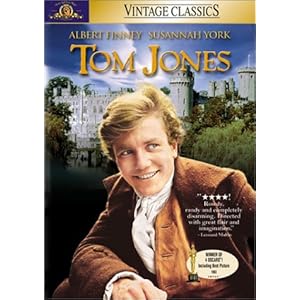
Tom Jones


There's something about 18th century England that is just inherently interesting to me. The British accents, the horrible class inequality, the technology still stuck in the beginnings of the Industrial Revolution, it's just... I don't know. Interesting. Tom Jones is based on a serialized novel published during that period, and features Albert Finney playing a bastard who's been raised in kind society and grown up to be a womanizer, well-liked by many but hated by some. The movie actually won Best Picture, which seems kind of strange, but I guess movies could do that back then without being dramas about serious issues or mediocre. Wow that was pretty harsh, I've actually really liked most of the recent winners of that award. Oh well, whatever. Tom Jones is funny, has an intriguing little plot about the secrets people sometimes keep, and has some nice performances. It also frequently features characters talking to or just looking at the camera, which somehow never gets old. And now that the movie has expired from Netflix streaming, the site doesn't have it at all. What's up with that, Netflix?
Monday, November 14, 2011

Movie Update 29

Well, here we are again.

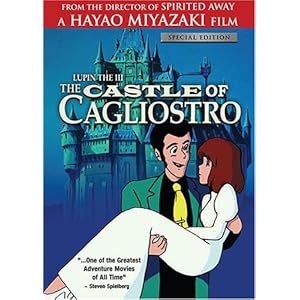
The Castle of Cagliostro


Hayao Miyazaki's first film as a director, before Studio Ghibli was a thing, is based on the Lupin III television series he worked on, which was based on a manga created by Monkey Punch, which was inspired by the Arsène Lupin character created by Maurice LeBlanc. The film's plot is also based on one of the original Lupin stories. So yeah, there's a lot of adapting going on here. Cagliostro is a lighthearted action adventure about Lupin and his buddies stumbling on the world's biggest counterfeit currency operation in one of its smallest countries, and trying to both thwart their plans and rescue a princess at the same time. I've only seen a bit of the show, but it doesn't take much of that to get familiar with the principal characters, and they all show up here and have fun little parts to play. It's a simple movie, but there's a nice energy to it, a reasonable amount of excitement in the twists and turns, and like all works by Miyazaki there's a nice feeling to the animation, which isn't the most fluid ever but does what's required to set the right tone. It's kind of a standard adventure movie, but it's a well executed one.

Killer's Kiss


Not Stanley Kubrick's first feature film, but the first that's readily available for public consumption. It's also his weakest that I've seen. There's nothing very bad about the movie, but there's just not much to it. A boxer meets up with a dancing girl, and they try to leave the city and start a life somewhere, but her crook of a boss isn't a fan of the idea. It's a pretty bare-bones noir story, with the only thing that really makes it work being Kubrick's great photography. There's lots of great little shots that stick out as distinct for the era, including use of reflections, some stuff with shadows that I haven't really seen before, and a memorable conclusion in an unusual setting. There's not much to the characters though, and the tacked-on ending doesn't really work. Its only real use is to show the potential Kubrick had for his work later on.

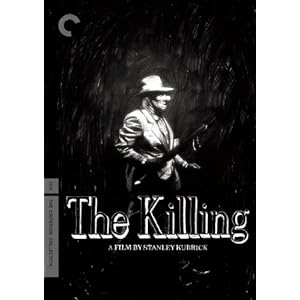
The Killing


The very next year Kubrick made this, his first really good movie. It actually feels a bit less distinctly his than Kiss, but it's certainly a lot more fun to watch, and might actually be the most purely enjoyable movie he ever made. In one of the few instances I can think of of him using an actor more than once, he has Sterling Hayden as the main character, a criminal trying to pull off one last job, robbing the take at a horse track, with a complicated scheme that involves multiple people both inside and outside the place. It's a pretty good plan, though there's also a lot of moving parts, and of course things get screwed up and the situation eventually gets pretty hairy. There's a lot of build up, and the pay off when it all starts falling into place is pretty great. Stylistically, there's not much in the movie that wouldn't be in another noir movie from the period. But it's also just a really good example of the genre, and sometimes that's all you need to be successful.

The Tree of Life

This is a film about life, and growing up, and pretty much everything that entails. I said before that I imagine a film by Terrence Malick entirely in his reflective/observing-nature's-beauty mode might get tedious, and that's somewhat true here, but the film is so beautiful and poignant that it's hard to be really bothered by the slow bits. The film isn't exactly in chronological order, but what it's basically about is Sean Penn remembering his youth growing up with his parents and two brothers, and also experiencing some sort of vision of the birth of the universe and what possibly lies beyond it. It's a staggeringly gorgeous movie at times, especially in the scenes showing the early moments of existence, with visuals that avoid computer animation in favor of more natural means. The more normal stuff looks great too, though it's mostly just people walking through houses or the woods. Brad Pitt plays his father, and does a really great job making him into a terrible dad that should really be feared and despised without being over the top about it. Just the way he touches his sons on the neck is enough to establish that loving parenting doesn't come naturally to him. I don't think the movie needed a name like Penn to play the adult version of the main character though - he doesn't really do much acting besides walking around and looking at things. The Tree of Life is a bit ponderous and in love with itself at times, but what it does right is memorable and unique enough to make the film worth watching, especially if you're a fan of film as a visually artistic medium.

Sunday, October 30, 2011

Movie Update 27

Three movie posts in a row? What the hell is this?

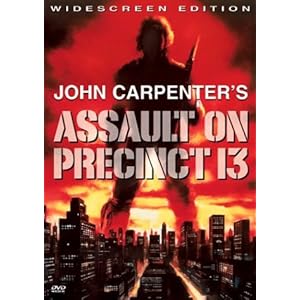
Assault on Precinct 13


A pretty early John Carpenter film, which can be seen as a super violent action movie before super violent action movies were really a thing. It has elements of westerns and zombie movies, and tells the story of a few police officers and criminals defending a closed-down police station from a fraternity of gangs on the warpath. There are definitely bits of the movie I liked a lot, as it manages to build suspense and have some solidly exciting scenes despite a low budget. There are definite issues with the script though, which is a bit lean in some places and is filled with tough action dialogue that I could barely tolerate, especially for the lead good guy criminal. Stop being cute and act like a human being for five minutes, man.

Going My Way


A Best Picture winner starring Bing Crosby as a priest who comes to a new church and helps make it a nicer place, mostly by using his musical talent to keep it going and form a choir with its population of young boys. There's not really a lot of depth to the movie, but I found it mostly enjoyable. On occasion the musical numbers (it's not really a musical, but does have a lot of singing) seemed to go on a bit long, but in the end it's a nice tale of spirituality and kindness and whatever. I like Bing. Bing's a pretty cool dude.

Last Year at Marienbad


When people talk about incomprehensible foreign art films, this is basically exactly what they're talking about. Marienbad is a French movie about a man who tries to convince a woman that they had met and had an affair a year earlier at another place, and either he's making it all up or she just forgot somehow or she's deliberately pretending she doesn't know what he's talking about. The movie never really explains itself, and I don't think there really is a straight answer anywhere. It's not that the scenes don't follow or are made up of gibberish, it's just that it's really difficult to tell when things are taking place or where or what's real or if any of it is. I appreciated the great artistry that went into filming it, but I also can't say I really liked it. There's just no way to make heads or tails of it.

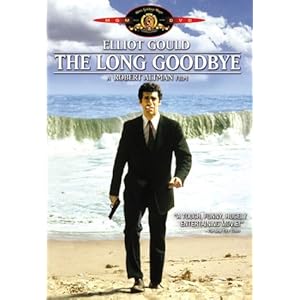
The Long Goodbye


My favorite classic film noir might be The Big Sleep, starring Humphrey Bogart as Philip Marlowe. Robert Altman and Elliot Gould revived the character in the 70s with The Long Goodbye, moving him into that decade and highlighting the anachronism of a 40s hardboiled detective living in a then-modern LA. Some people don't like the way the movie plays with the genre or the deviations from the original novel, but I thought it was a mostly entertaining movie. It's also funny to see a very early appearance by Arnold Schwarzenegger as a thug who doesn't have any lines. Not a traditional detective story, but I think it's an interesting one.

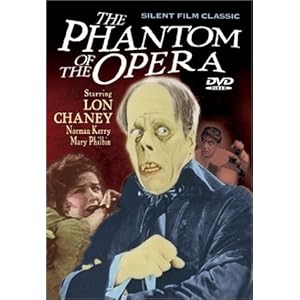
The Phantom of the Opera


You know, I always got the impression that the Phantom was supposed to be a sympathetic figure, like his horrible visage masked a kindness and he was only secretive because of a life of torment, or something like that. But he really isn't. He kidnaps a woman and basically tells her he'll kill everyone if she goes back to her boyfriend instead of staying with him. Not cool, dude. This version of the story from the 20s is probably the best known film version, and it's pretty watchable, though not terribly exciting now. Lon Chaney's makeup is pretty good, but there's not much about the movie that's really scary. Not much of the good imagery from other silent horror classics. Still, probably worth checking out.

The Private Life of Sherlock Holmes


I guess there's some disappointment that when Billy Wilder makes a Sherlock Holmes movie that begins by teasing that its story will be surprising and possibly controversial, and the ends up just being a pretty normal Sherlock Holmes movie. In fact, the entire opening sequence where he lies about his sexuality to get out of a jam and which is the only thing that's truly original about the story, ends up being kind of a waste of time as it only barely plays into the rest of the film. It's not a big deal though, because it's a well paced, interesting mystery for Holmes and Watson to solve, with plenty of clues that seem odd at first but end up coming together to make a strange sort of sense. No Moriarty here, but we do have Christopher Lee as Mycroft, which is pretty delightful. Not an outstanding movie but a fun one. Not sure about the new Guy Ritchie sequel, though. Is it just me, or are none of the jokes in the previews actually funny?

Rome, Open City


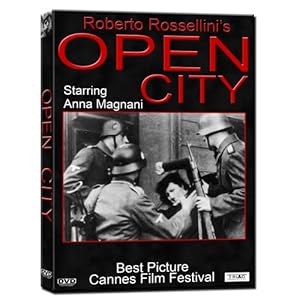
Italian neorealism! Catch the fever! Open City is remarkable for its depiction of the late Nazi occupation in Italy only months after the war actually ended, and for how unflinching it is in depicting the period. They didn't experience some of the worst horrors of the war, but it sure wasn't fun to resist the Third Reich at any point during their reign. The film suffers a bit from Italians Yelling a Lot Syndrome, but it's a well crafted piece of historical fiction, and I'm still impressed by it following so soon after the actual events it tries to reflect. A solid way to help kick off an important film movement.

Friday, October 28, 2011

Movie Update 26

Sometimes movies are all you really have to talk about, you know? You've got other stuff going on, but there they are. Movies.

The Cabinet of Dr. Caligari


One of the original horror movies, and a pretty good one. Dr. Caligari is notable for its early use of a twist ending and famous for the abstract design of its backgrounds, but it would be pretty effective even without those. The story is a bit slight, but the movie tells a fairly entertaining tale about a Frankenstein-esque mad scientist and his murderous somnambulist creation. Some nice creepy images, and just a solid mood that would help lead to more sophisticated takes on the genre concept. An important silent movie that manages to be watchable.

My Darling Clementine


Another black and white John Ford western, though I really didn't like this one as much. It had some nice scenes, but it was mostly just kind of slow. Henry Fonda plays an amiable Wyatt Earp, but that's about it. It's the story of the OK Corral, with a lot of inaccuracies and changes that don't really improve the drama of the story or make it more interesting. Ford knows how to shoot movies, and for its age Clementine is well shot. But sometimes he just forgets to make a truly entertaining movie, and this is one of those times. I think Westerns are among the genres most hurt by being confined to 4:3 black and white boxes, and while it didn't bother me much with Stagecoach, I think it definitely was to this film's disadvantage. I would have liked to have seen how it would have turned out ten years later.

The Palm Beach Story


Like the other Preston Sturges movies I've seen, Palm Beach Story is kind of weird. It's more overtly weird though, in that the plot ends up being completely silly. It's a pretty normal screwball comedy featuring the guy from Sullivan's Travels and the girl from It Happened One Night, only their story is one of a marriage falling apart rather than one coming together. Of course things end up about how you'd expect for them, but the ending kind of throws that away with a kind of bizarre plot twist. Like other Sturges movies it has solid actors delivering a lot of fun dialogue very quickly, but there's not much else besides that.

Pierrot le Fou


Sometimes I wonder who determines whether a film will be internationally known by its original title or a translation. It took a few tries, but I found a Jean-Luc Godard film that I really like. Fou combines some elements from other work by him that I've seen, like the vibrant yet natural cinematography of Contempt and the existentialism and fourth-wall breaking of Breathless, but puts them in a story I actually found interesting. The star of the latter film and Godard's eventual ex-wife play a couple that runs away from their responsibilities and some Algerian gangsters with a bunch of their money. It's not quite as exciting as that sounds, but the course of their relationship is intriguing and it's just kind of a fun movie to watch. Definitely very French, but not in a bad way.

Monday, October 24, 2011

Movie Update 25

Seems sometimes like all I do is watch movies. But that's not true.

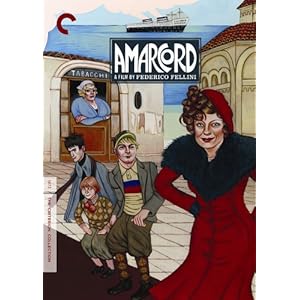
Amarcord


One of two films by Federico Fellini I saw this weekend, and the first I've seen in color. It's more autobiographical than his other work that I've seen, and thus more prone to not actually having a plot. It shows the crisscrossing lives of many people living in a small Italian village over the course of about a year during Mussolini's time as dictator. It pokes a lot of fun at the politics at the time, when it's not just depicting small town living. It's a fairly amusing film, but it didn't really grab me. I'm not against simple slice of life stories, but for whatever reason I wasn't really drawn into this one. Nicely done, but not much impact.

Au Hasard Balthazar


A good way to depict suffering and cruelty is to inflict it on something that's completely innocent, and that's what Robert Bresson does in Balthazar. It shows the parallel lives of a young farm girl and her family's pet donkey, as they grow older and face the harsh realities of growing up and being subject to the whims of someone stronger than you. I focused mostly on the donkey, just because it's such a pitiable creature and it's hard to watch what people do to it just because they can. If you want a prime example of a foreign art house movie that shows what's wrong with humanity without hitting you over the head with it... well, here you are.

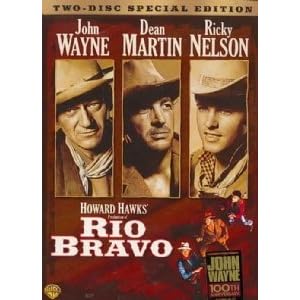
Rio Bravo


Rio Bravo was made as a response to High Noon, which some such as Bravo's star John Wayne saw as un-American. It has a similar premise of the sheriff of a small, dusty town facing the looming threat of a criminal preparing to come and cause trouble, but rather than asking the town he protects for help, he faces the threat head-on. Of course, he has a couple buddies who are even better with a gun than him, and in general the town just treats him better. I liked Rio Bravo about as much as High Noon. Its approach is different, but it's a more entertaining, if less intense Western. The cast is solid, and Howard Hawks' direction is spot on. I liked High Noon because it was different from most films of its type at the time, but there's value to something just being well made too.

Stagecoach


John Ford's first sound Western, and the breakthrough movie for John Wayne. Solid character actors like John Carradine and an Oscar-winning Thomas Mitchell appear as well in nice roles. A stagecoach tries to make it through Apache territory to a town where Wayne's Ringo Kid intends to face down the man who murdered his loved ones, but there's a marshal riding shotgun who wants none of it. Parts of the movie are a bit slow, including the ending, which took a bit too long to resolve all of its little plot threads. There's some really good stuff here though, with Ford's direction seeming to be ahead of its time. A long chase through the desert that makes the film's climax in particular is just a brilliantly done sequence, and is easily one of the best action scenes from the era. One of the most important movies in the genre.

La Strada


The other Fellini movie I saw, and my favorite work by him. It stars his wife Giulietta Masina again (or first, as this was made the year before Nights of Cabiria) as a slow but well meaning girl who gets sold by her mother to a traveling strongman after her sister who filled the same role dies. She shows obvious talent as a clown, but when the two join a circus and a conflict erupts between him and a fool, bad things start happening. It has a predictably morose ending, but the journey there is at times heartwarming and devastating. Comparisons have been made between Masina and Charlie Chaplin, and I definitely see it. She definitely has that physical comic sensibility, and her character is the naive sort that reminds you heavily of the Tramp. Really good performance, even if there's no scene as great as the end of Cabiria.

To Be or Not To Be


A comedy made during World War II, depicting a troupe of Polish theater actors that use their stage talents to try to sneak their way out of their city, which has been occupied by the Nazis. It's a delicate balance between making fun of Hitler and Germany without ignoring the truth of the situation, even if at the time the full extent of what they were doing wasn't known. Still, I think it works as a comedy and as something that could lift spirits in the face of a devastating war. Carole Lombard unfortunately died in a plane crash a couple months before this was released, but it would be a fitting final performance for just about anyone.

Wednesday, October 19, 2011

Movie Update 24

Would you believe I've seen a few more movies since the last time I wrote about a few movies? The first three of these are the second film I've seen by their well-regarded directors, and the last is the first by another.

All About My Mother


This is a movie that could have gotten unbearably depressing, but something about the colorful way it looks or its deeply human characters or the faith it has in humanity or something kept it watchable, and made me really like it a lot. Pedro Almodóvar seems to be a director's who's a lot more in tune with women than many men in his profession, and even dedicated the movie to them at the end. It's about a woman who loses her son, and then journeys back to her old stamping grounds, where she meets some old friends and makes some new ones. Penelope Cruz is the only one I remember seeing anywhere before, but they almost all instantly become likable, even if they're flawed as people, and it's an interesting movie just to watch. A lot of bad things happen, but hope never completely runs out. At least that's what I took from it.

Chungking Express


Wong Kar-wai employs a very unusual structure with this film. It's not that weird to split a narrative between two different and only tangentially related stories, but it's a good deal weirder to separate them almost completely in editing, with one going through all its paces and then wrapping up before there's a quick transition to the second. They're both love stories featuring lonely policemen and a snack bar, and they both have thematic similarities, although there are definite differences as well. I don't like all of the choices Wong makes, such as the low shutter speed effect when things are happening quickly, but it's mostly a well made, well acted drama. Wong impresses me about as much as any Asian filmmaker who's still working.

Contempt


Made only a few years of Jean-Luc Godard's Breathless, Contempt sure looks a lot different. It's in widescreen and color, and the differences don't really stop at an aesthetic level. It's a very natural film, examining the breakdown of a screenwriter's marriage while he's also struggling with his current project. He's rewriting a script for an adaptation of The Odyssey (why hasn't their been an actual legitimate film version yet?) which is being directed by German auteur Fritz Lang (playing himself), and he finds himself disagreeing with his boss and then his wife after she meets him. A lot of the film is just the writer and his wife talking, evading the issue of what's really going on while being cruel to each other. It doesn't sound that exciting, but Godard does some really interesting things with the presentation of the material that makes up for it. You can read a lot of symbolism and analogy into it, or you can just enjoy the impressive cinematography and Brigitte Bardo's figure.

Written on the Wind


In the past, critics have looked at Douglas Sirk's work in two different ways. When he was contemporary and his films were making money in theaters, he was criticized for making old fashioned, overwrought melodramas. Later though, others saw a certain irony in what he did, like he was prodding at the falsehood of the American dream without calling too much attention to it. Watching the movie, I could see it both ways, but I would tend to agree with the more recent interpretation, because I have a hard time believing someone  who was so good at creating images on film could be so bad at depicting human interaction in the world of 1950s cinema. Maybe he just lucked into great directors of photography, but in any case, the irony is there, whether he intended to have it or not. Written on the Wind is a big movie with big emotions, and it's interesting to look at the absurdity of rich people at any point in history, so I had a good time watching the film and wondering about its real intentions. It's not perfect, but I'm pretty sure I liked it.