Seems sometimes like all I do is watch movies. But that's not true.
Amarcord
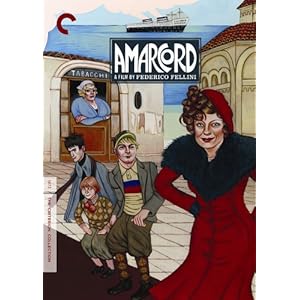
One of two films by Federico Fellini I saw this weekend, and the first I've seen in color. It's more autobiographical than his other work that I've seen, and thus more prone to not actually having a plot. It shows the crisscrossing lives of many people living in a small Italian village over the course of about a year during Mussolini's time as dictator. It pokes a lot of fun at the politics at the time, when it's not just depicting small town living. It's a fairly amusing film, but it didn't really grab me. I'm not against simple slice of life stories, but for whatever reason I wasn't really drawn into this one. Nicely done, but not much impact.
Au Hasard Balthazar

A good way to depict suffering and cruelty is to inflict it on something that's completely innocent, and that's what Robert Bresson does in Balthazar. It shows the parallel lives of a young farm girl and her family's pet donkey, as they grow older and face the harsh realities of growing up and being subject to the whims of someone stronger than you. I focused mostly on the donkey, just because it's such a pitiable creature and it's hard to watch what people do to it just because they can. If you want a prime example of a foreign art house movie that shows what's wrong with humanity without hitting you over the head with it... well, here you are.
Rio Bravo
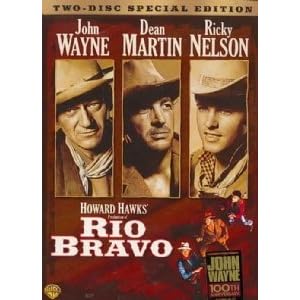
Rio Bravo was made as a response to High Noon, which some such as Bravo's star John Wayne saw as un-American. It has a similar premise of the sheriff of a small, dusty town facing the looming threat of a criminal preparing to come and cause trouble, but rather than asking the town he protects for help, he faces the threat head-on. Of course, he has a couple buddies who are even better with a gun than him, and in general the town just treats him better. I liked Rio Bravo about as much as High Noon. Its approach is different, but it's a more entertaining, if less intense Western. The cast is solid, and Howard Hawks' direction is spot on. I liked High Noon because it was different from most films of its type at the time, but there's value to something just being well made too.
Stagecoach

John Ford's first sound Western, and the breakthrough movie for John Wayne. Solid character actors like John Carradine and an Oscar-winning Thomas Mitchell appear as well in nice roles. A stagecoach tries to make it through Apache territory to a town where Wayne's Ringo Kid intends to face down the man who murdered his loved ones, but there's a marshal riding shotgun who wants none of it. Parts of the movie are a bit slow, including the ending, which took a bit too long to resolve all of its little plot threads. There's some really good stuff here though, with Ford's direction seeming to be ahead of its time. A long chase through the desert that makes the film's climax in particular is just a brilliantly done sequence, and is easily one of the best action scenes from the era. One of the most important movies in the genre.
La Strada

The other Fellini movie I saw, and my favorite work by him. It stars his wife Giulietta Masina again (or first, as this was made the year before Nights of Cabiria) as a slow but well meaning girl who gets sold by her mother to a traveling strongman after her sister who filled the same role dies. She shows obvious talent as a clown, but when the two join a circus and a conflict erupts between him and a fool, bad things start happening. It has a predictably morose ending, but the journey there is at times heartwarming and devastating. Comparisons have been made between Masina and Charlie Chaplin, and I definitely see it. She definitely has that physical comic sensibility, and her character is the naive sort that reminds you heavily of the Tramp. Really good performance, even if there's no scene as great as the end of Cabiria.
To Be or Not To Be

A comedy made during World War II, depicting a troupe of Polish theater actors that use their stage talents to try to sneak their way out of their city, which has been occupied by the Nazis. It's a delicate balance between making fun of Hitler and Germany without ignoring the truth of the situation, even if at the time the full extent of what they were doing wasn't known. Still, I think it works as a comedy and as something that could lift spirits in the face of a devastating war. Carole Lombard unfortunately died in a plane crash a couple months before this was released, but it would be a fitting final performance for just about anyone.


AAAAAGGGHHHH
17 years ago


