Leap Day seems like an appropriate point to make a major decision about how I spend my free time.
It's been over a year since I decided to streamline my approach to this blog (and the time I spend on entertainment), and it's been to my benefit to do so. I think it's time to do so again, because while the changes have made it easier on me, I still find myself wondering why I do some of the things I do. Why spend time typing up single paragraph summaries of things I've experienced, with no actual interesting analysis or entertainment value to justify it? I don't need to tell myself what I've seen and done, and no one else is being served by it either. I'm not going to stop blogging, but I'm going to stop doing so when I don't actually have anything to say. I want to start writing in a way that if someone were to stumble upon what I've written, they would actually be interested in reading more. Less fluff, and more actual thought. I thought a new blog with a new name and a clean slate would be best for such a significant change, so I'm going to work on that, but in the meantime this is probably going to be it for this blog.
When I have actual content to show for my attempt to do this blogging thing right, I'll post a link here, but more importantly on Twitter, where you probably got to this post from, unless you came from Things That Don't Suck, my Internet Friend Bryce's much better blog, and apparently my biggest traffic driver besides Google. So, thanks for that, Bryce. I might keep the posts with my various compulsively maintained lists updated, but other than that, this has been Pretty Sure I'm Right.
Wednesday, February 29, 2012
An Ending, of Sorts
Tuesday, January 31, 2012
Deadeye Dick

At this point, the formula for a Kurt Vonnegut novel is so clear and familiar that it's almost completely transparent, but they're still so enjoyable to read that it's hardly worth caring. Like a lot of his work, Deadeye Dick is less a novel with a plain, straightforward narrative and more of a jumbled memoir of a character who seems like some possible version or aspect of Vonnegut himself, examining the absurdities of life and America and society through events that range almost everywhere on the scale between hilarious and depressing. He had his method down to a science by the 80s, and the result is yet another easy to read book that I liked a lot and wouldn't mind going through again.
This particular book is about Rudolph Waltz, a man born in the 1930s to very silly parents and whose entire future is affected when he accidentally does something horrible when he's twelve years old. We learn a lot about his life and the lives of his close family members, and also little snippets about the various other residents and famous events in Midland City. As far as recurring Vonnegut elements go, the novel returns to science fiction with the concept of a neutron bomb that can wipe out the residents of a town without actually affecting the non-living landscape, and it shares a location and some characters with Breakfast of Champions. I'm not sure that the two stories can actually be reconciled into a single continuity, but that was never the point of Vonnegut's writing anyway. Deadeye Dick isn't his most innovative or surprising work, but it's still a very entertaining and occasionally poignant novel, which is pretty much the writer's real trademark.
Sunday, January 8, 2012
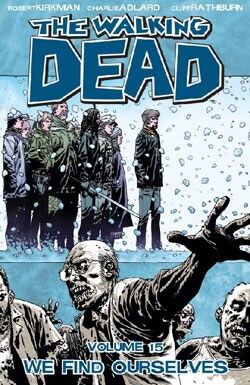
The Walking Dead, Volume 15: We Find Ourselves

Either the book has started to just throw new characters into the story without properly introducing them first (valid given the current situation in the plot), or I'm forgetting some of them in the time it takes for a new volume to come out. My guess is that it's the latter, and that's probably just the reality of reading a comic while it's still coming out, but only in the trade paperback collections. I think part of it though is that things are a bit muddled at this point. There are a whole lot of living characters right now, possibly more than there's ever really been at any point, at least only counting ones that have been given names and things to do. And none of them are really doing that much. There's a bit of a struggle in this volume between some people, but it's over quickly and doesn't have any real consequences. There's very little threat from zombies, either... they're out there, but there's nothing major. It's just sort of a transitional part of the story, taking place shortly after some major events and presumably setting up others. But it's a little underwhelming when it's the only stuff I've read in a few months and I won't read any more for another few. So, yeah. It's fine, there's nothing wrong about it, but at this point it's inessential.
Monday, December 19, 2011
Jailbird

I've probably said it before but it bears saying again. While Kurt Vonnegut is best known as an author of unusual, satirical science fiction, some of his best work takes place in the real world, or at least something very close to resembling it. Jailbird proves this once again, and after I found his previous book to be underwhelming, it was nice to read another great Vonnegut novel again. He was getting older at this point, which is reflected in the story's main character, a man in his sixties who's seen the world change a lot over time and has stopped taking it entirely seriously. Jailbird reads more like a fictional autobiography or memoir rather than a traditional novel, and has the protagonist telling the story of his first couple days of freedom after being jailed for two years for his involvement in the Watergate scandal, though it's fairly rambling, covering at different points many different periods in his earlier life and also obliquely referring to his state at the time of the writing a few years later. There's also a very long prologue (it is literally more than 10% of the book's text) written from Vonnegut's own perspective which mentions things that inspired pieces of the story and also expands on some fictional events that are referred to but left unexplained in the main text.
So there's the typical Vonnegut playfullness in the writing, and the topics he decided to brood on here are pretty expected as well. He talks pretty harshly about the history of the treatment of certain American citizens, from laborers who wanted to start unions to communists who were persecuted by the government after the war. He weaves the different characters into the fabric of America from the 30s to the 70s, as the protagonist goes from a reluctant Harvard man to a successful bureaucrat during World War II to an unemployed loser to a forgotten small part of the Nixon administration before his eventual incarceration. The RAMJAC corporation is a creation of Vonnegut that pops up repeatedly and proves essential to both the plot and his most biting condemnation in the book, giving not just corporations but our entire economic system a pretty thorough lashing. For all of it's preaching though it wouldn't be a very enjoyable book without his trademark oddness and sense of humor, and luckily both are also fully intact here. As he gets older he seems more willing to touch on taboo subjects, and some of the laughs in Jailbird are as strange and biting as they've ever been. It's not quite one of the best books he's written, but it's certainly right up there with other great things he's done.
Friday, November 25, 2011
Deadhouse Gates

It ended up taking me most of a year to read this book, but that was more because I've been short on free time and reading tends to take a backseat when that happens, and less because I didn't like it. I ended up liking it probably more than the first book in the series, though it again took a while to really get into anything resembling a groove. It features four returning characters, but they only occupy two out of six or so main story threads, with the rest focusing on new faces, and again it's quite a bit of time before most of them seem to start connecting and involving themselves in something that could be called a plot.
It's hard to say whether this struggle early on in the books is a fault of Steven Erikson's writing or if it's just my failure to consistently read them, but usually I can only focus on doing so when I can tell what's happening and am enjoying it. Compared to some other series I've read, The Malazan Book of the Fallen can be pretty obscure. Your eyes can glaze over an entire paragraph if there are too many strange words in it, and if anything really happens in that paragraph, you can struggle with understanding it for a while. But when it works it works really well. I know the series gets weird with its chronology later on, but Deadhouse Gates is a straight sequel to Gardens of the Moon, and it expands on ideas from that book without necessarily requiring you to have just read it. The book uses some pretty dark and violent imagery to effective sell the significance of its events, and at some point it really does get gripping with me reading the last hundred pages in a couple hours. 11 months is definitely too much time to spend on a single book, but I'm prepared to blame that on myself and say I want to continue reading the series.
Sunday, August 14, 2011
Serenity, Volume 3: The Shepherd's Tale

Somehow, I have repeatedly forgotten over the last several months that I read this and was able to write about it. But that's not a knock against the comic itself, it's just one of those weird things that happens. The only disappointment about finally learning Book's backstory all these years later is that it doesn't take that many pages to do. In the end, his secrets aren't all that secretive, the kind of things that most people wouldn't talk about, but they aren't world-shaking revelations either. Zack Whedon's script makes the way the story is told more interesting than the story itself, using a very familiar technique to turn a man's life story into an intriguing plot with many twists and turns. It's told backwards, starting around when he's with the Serenity's crew and jumping back years at a time, revealing his time with the Alliance and the earlier events that led to it. There's not much to it that you haven't seen before in science fiction stories, but just seeing how it all works into what the show set up and just spending a bit more time in the Firefly setting is always fun. It's not the best value for money, just based on page count, that you'll find in the world of comics, but I can't imagine many fans thinking it's not worth checking out.
Saturday, August 13, 2011
The Walking Dead, Volume 14: No Way Out

Recent volumes of this book have really pushed the idea that when the world is overrun by zombies, other people are just as dangerous as they are. But No Way Out really brought back the threat of the zombies themselves in a big way. The good guys are surrounded on all sides yet again, and as can be predicted, some seriously messed up stuff happens as they fight to survive. It's at the point in the book that I really can't bring myself to care about anyone anymore, because Rick is literally the only character that I don't think Kirkman would be willing to kill, if only because he's the lens through which most of the story is shown. And he's done too much out of self interest at this point to let me think of him as a real hero at this point. He's just a good survivor. I read not because I hope the characters will see things through, but out of a certain morbid interest in what the next awful moment will be. This book had a few of them, and there was little I could do besides chuckle in disbelief as I saw them come to pass. This was an extremely violent book (they usually are), but for whatever reason it hit home just how good the book is at throwing tons of horrific imagery at you. I can see how someone without empathy and a passion for monster movies could love the hell out of it. As it is, I manage to enjoy it quite a bit.
Friday, July 22, 2011
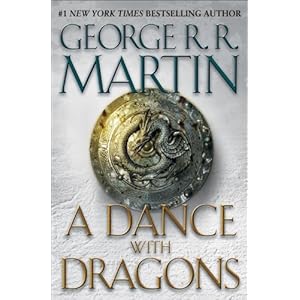
A Dance with Dragons

I think if I had been reading this series all along and had been waiting for this book for six years, I'd be a little disappointed. Luckily, I was waiting for less than two. While a bit of that feeling is still there, overall I loved the book while I was reading it and just enjoyed seeing more of that world. The Game of Thrones TV series is a worthy adaptation, but there's only so much you can show in ten hours, and getting back into the books, I was reminded of the almost absurd amount of detail within the writing. People make fun of George R. R. Martin for being fat, and he calls himself a "talented eater". His passion for food definitely shows up in the book, as pretty much every meal a character gets within sniffing distance of is described in detail. It's something I didn't really notice before, but after it was pointed out, it was kind of funny to see how much time is spent on just what people happen to be eating while wars are planned and secrets are revealed. It's not just the food that gets a lot of attention, pretty much everything you could want to know about the world is spelled out, from family trees to clothes to heraldry, sometimes repeatedly. It could have resulted in tedium, but I love the setting as much as anyone, and I love the focus it gets in these books.
The story definitely slowed down during the fourth and fifth books, which take place mostly in parallel. After a certain point characters and locations from the fourth book start appearing again, though generally it's just to give us a quick update on their situation before jumping back to the main threads of the story in this volume. The problem with the book is not the world count, or the increasingly large number of subplots sprinkled all over the world, it's just that not quite enough forward progress seems to be made in most areas. I think these two books came out of a planned skip forward in the series' timeline that ended up not happening, and there's a feeling of waiting in many of the characters' stories. Some POV characters are in positions of authority and mostly just try to manage their current situations, others make an expected progression in their personal arcs and then just drop out of the book completely.
There doesn't seem to be much of a climax to the story, things do get pretty exciting and even significantly game-changing near the end, but because of the staggered way all of the plots end up finishing, it sort of feels like Martin just decided to stop writing at a certain point after failing to find a suitable climactic event. I know he has a fairly significant amount of the next book already written, and I think he probably just cut it off to keep it to a semi-reasonable word count. Not that the cliffhangers he set up aren't intriguing and good fodder for speculation during the wait for the next book, it's just the way the story has swelled over the years make it hard to have everything seem totally cohesive. All that said, I had a great time reading the book, and continue to hope and believe Martin has some sort of plan that he's driving toward. He recently admitted that he might have to write three more books instead of two to wrap up everything, but if that happens, I'll try to appreciate the extra time spent in Westeros more than I rue the extra years of waiting for the ending.
Sunday, May 22, 2011
Fantastic Four, Volumes 1-4

Jonathan Hickman was the writer chosen for the final arc (as of now) for Fantastic Four, which resulted in the widely reported death of the Human Torch and the monthly book being retitled FF, which stands for Future Foundation. I've never been that into the group, but this was a pretty solid storyline with a lot of crazy stuff going on, all delicately balanced to keep from getting out of control. The Fantastic Four were already a pretty weird group, as befitting super heroes with an origin story that involves them being in outer space. They were already into some advanced stuff when they were turned into freaks thanks to Reed's superb intellect, and putting those together combines for some wild ideas. There's so much going on in these 19 issues; parallel universes with parallel Reeds working together, a bunch of his dads collapsing into one timeline, the discovery of several cities with new civilizations running them, Galactus finding his future corpse and getting PISSED, and the fact that I didn't lose my mind reading it probably speaks to Hickman's ability.
Some of the concepts are pretty silly, or just not given enough time to be explained when he jumps to some new thing he wants to talk about, but it kind of works to create a sense of chaos that builds towards the climax, where not everything is resolved but a pattern emerges and a big emotional event happens for the characters. It's hard to care much about Johnny because I don't have a history of affection for the group and the refusal of most comic book characters to stay dead is pretty infamous, but it's still a well-realized moment, and the epilogue issue of mourning is a departure for most mainstream books and fairly interesting. Plus it had a good Spider-Man scene, so that's a bonus. I don't expect I'll be reading any FF, but I appreciate the occasional opportunity to check out some of the more prominent story arcs that go on in this universe, which are never as resonant as the books I read more regularly but still worth a quick read. Comic books!
Sunday, February 20, 2011
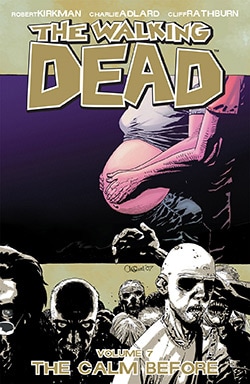
The Walking Dead, Volumes 7-13

Partly thanks to actually having an income, I have read more of The Walking Dead than I have in the last couple months than I did in the last couple years. Having 42 issues to talk about rather than only six doesn't actually leave me with that much more to talk about, because I'd rather avoid going to much into the details of the plot as usual. Suffice it to say that zombies are still everywhere, and people die just as quickly as they are introduced. Part of what I like about this rotating cast is that that it allows the dynamic of the group to change greatly over time. I'm currently working my way through the British TV series MI-5, and while I appreciate how they're willing to change up the cast frequently, it's pretty obvious when a new character is dropped into an old one's basic niche without it actually changing the show's formula too much. But the new blood in The Walking Dead definitely changes the story, and it's interesting to watch relationships evolve with time. Also, these volumes really dug deep into the idea of humanity being the real danger in a world where society has been destroyed, even more than the earlier stories, and that stuff tends to be much more chilling and depressing than any regular horror story can. But while the series works well as a study of humanity in an extreme setting, I don't think I'll ever count it among my favorite comics because there just isn't enough of a plot for me to really get invested in. Live goes on for these people until they die, and the book seems like it will go on in much the same way until it ends. I'll stick with it for a while though, at least.
Tuesday, October 12, 2010
The Godfather

The Godfather is an interesting read, even if you've already seen the movies. It covers the same basic ground as the original film and the De Niro flashbacks from Part II, while filling in a ton of background detail that makes the story clearer and more fleshed out. Puzo and Coppola's screenplays weren't exactly lacking in content, but reading the actual novel was certainly a worthwhile companion experience to the films. Even if it invalidates parts of the third movie.
So the story follows the same basic structure as the first movie, and it's divided into nine "books", each a different section of the plot. The first one is easily the longest, but after that the characters drift apart a bit and the books tend to focus on one in particular. The biggest parts that were left out of the films are significant subplots involving Johnny Fontane and Lucy Mancini, the Frank Sinatra stand-in who needs the Godfather's help to save his career and the maid of honor that Sonny spends time with at his sister's wedding. These parts are more mundane than the crime and violence of the main plot, but really no less well written, and really bring a bit of humanity to the book.
Time is even spent giving backstories to characters whose only roles in the film were either to kill someone or get killed in a single scene without saying a word. It all adds up to making the world of the book seem bigger than in the films. I'm not saying one should necessarily replace the other, because the drama of seeing something on the screen can be greater than reading it on the page, and they remain some of the best made movies ever. They compliment each other well, and the movie really has everything you need to understand it, the book just gives it all a little more significance. It's also pretty easy to read, descriptive without being overly flowery, although the timeline did get a little muddled in a couple places. Still, the story was quite understandable, and it's a good one at that.
Saturday, October 2, 2010
Slapstick

Vonnegut's eighth novel is not exactly one of his best, but I still found it pretty enjoyable. He calls it "the closest thing" he'll ever write to an autobiography, and it begins with a relatively long prologue that is both funny and surprisingly poignant, where he writes about how he came to write the book and reveals where a lot of the pieces of the plot came from before you actually know they're in there. The novel itself follows at a very brisk pace, with this being one of the quickest to read Vonnegut books I've tackled. The writing style just lends itself to being absorbed in huge chunks, because it's very disconnected with extremely short chapters. Despite the small word count the plot itself isn't very dense, so it's quite simple to just power through in a couple sittings.
And you don't mind doing so because it's pretty funny and has some weird new ideas. The whole thing is written as the late-life memoir of a pretty strange man, born a freak with an unusual attachment to his twin sister, eventually growing to be President of the United States as the country slides into anarchy as the result of some strange diseases. Some of the stuff from his youth gets pretty uncomfortable, and the descent of civilization is just downright odd. While capable of providing a few laughs, the strongest part of the story might just be its structure, with the way it slowly fills in the picture from both directions, and a few pretty good bits of foreshadowing just from putting two and two together with the way it was written. Again, not really one of my favorites, but still a pretty enjoyable book from a great author.
Thursday, August 12, 2010
God Bless You, Mr. Rosewater

Of the seven novels by Kurt Vonnegut I've read, this was definitely the funniest. I've talked about how the two biggest recurring elements in his work are depressing uses of technology and dark humor, and the scale is pretty much fully tipped towards the latter here. Eliot Rosewater is one of Vonnegut's favorite characters, appearing in multiple books after this one, and I have to say I enjoyed his starring story a whole lot. It struck me at a certain point that it was sort of like one of the less serious Coen brothers movies in novel form, which was sort of an epiphany on my taste. Whether on film or in print, I sure like off beat and occasionally black as night humor.
As far as Vonnegut plots go, Mr. Rosewater's is fairly mundane. He was born into money, and is the president of a foundation that manages his family's fortune. An ambitious lawyer discovers that any president of the foundation that is found insane must relinquish control, and since Eliot has failed to have a child with his European wife, that means the power would transfer to his schlub of a cousin in Rhode Island. The lawyer believes he can get a huge chunk of that inheritance if such a transfer were to occur, and with only a minimum of digging finds that an insanity case might end up being pretty easy.
There's sort of three phases to the book. The first and second explore the lives of Eliot and his cousin respectively, less concerned with hurrying the plot along and just sort of exploring what their lives are like. The funniest bits tend to be whatever comes out of Eliot's mouth, though even when he's not around it's hard to read for any length of time without something humorous coming up. The last act is pretty brief and fairly climactic, a bit confusing on first read but explaining itself fairly well in the last chapter. If there was a Vonnegut book I wouldn't have minded being a bit longer, it was this one, but it was still an excellent, quick read and certainly in the top tier of his work.
Thursday, August 5, 2010
Player Piano

Kurt Vonnegut's first novel is sort of an interesting case. It's his wordiest work that I've read, and in some ways it's unique because it doesn't seem like only he could have written it. His style is visible but not fully formed yet, and it's like he wasn't sure who he was yet. A lot of his trademarks are there, like interesting applications of then-cutting edge but now old fashioned technology, a dystopian view of mankind's overall mentality, and some black humor. But it's just missing that economy of language and particular wry wit that would make it distinctly his. It was a pretty good book, but not one of his greats.
It's interesting trying to figure out when the book is supposed to take place, too. It was published in 1952, and is clearly set in a future where machines have too much control of society, but it's hard to say how far in the future. It takes place a generation or so after "the war", the United States' supposed final military conflict before they set up their new, more efficient society. But while it might have been World War II (albeit an alternate version of it), it seemed more like another one after it. The prominent use of now-dated technology like tape recorders to control various automated functions makes it unclear how far forward he intended it to take place, although I would guess sometime before now. It makes for an original setting that probably won't be replicated, and a curious backdrop for the story.
It's about Paul Proteus, an engineer and son of a legend of a man who was one of the most powerful in the country before he died. The world is placed before him in his career, but he grows increasingly displeased with the system and his life, while one of his old friends becomes involved with an organization that wishes to overthrow the machines' power in the society. It ended up taking on a more traditional story structure than I really expected, and some of its ideas seem kind of quaint now, but it had a surprising amount of things to say that would be relevant now. His ideas have always been a bit too nuts to take their warnings too seriously, but Kurt Vonnegut could probably make a compelling argument about anything he wanted. It was a bit preachy in places, but it was overall a pretty good first work by one of my favorite writers.
Monday, July 26, 2010
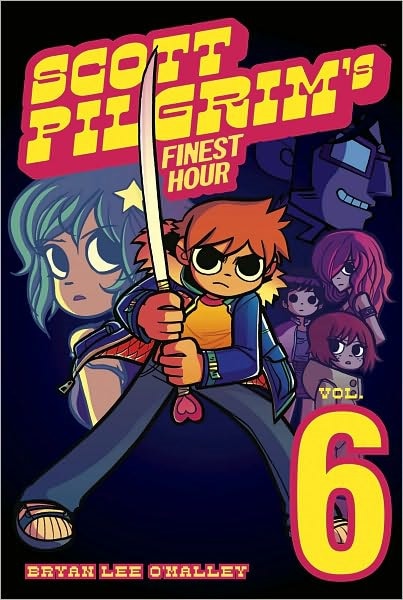
Scott Pilgrim, Volume 6: Scott Pilgrim's Finest Hour

To be honest, reading the first five volumes of this book in about a month and then having to wait over a year to see the end is sort of an awkward way to take in the story. It might just be my own perception, but it felt like this final part flowed as its own story the worst of any of the chapters, and definitely seems like it would work best at the end of a long marathon read of the whole series. I'll probably do that at some point, but for now I'll just accept that it was a satisfactory ending to the story rather than an amazing one.
The problem I guess is that it feels really segmented and choppy, which was intentional due to the state Scott is in for most of the book. He's sort of a wreck, and the story portrays this as a series of moments rather than a more continuous narrative. It leaves any individual page in the volume seeming totally fine and up to the usual standards, the flow just seems a bit off compared to earlier parts. And so much time is dedicated to the final confrontation that there really isn't enough room left for the expected amount of character work. O'Malley does a good job of trying to at least give closure to as many relationship threads as possible, the effort just comes off a bit rushed.
The final battle itself was similar to the end as a whole, enjoyable if not spectacular. The action itself was pretty good, and the continued use of video game ideas as visualizations of character development continued to be clever. But it was a bit bogged down in its attempts to explain what was really going on with the different characters in the last year, and that bit doesn't work that well. People were explaining things, but a lot of the explanations didn't make sense or seemed to lack details that would really fit them in place. There were a couple interesting revelations, but I don't think I quite got out of it what I was supposed to. I thought the epilogue and ending themselves were pretty good, it sort of could have gone in a number of ways but I think the right one was picked. In the end, it wasn't the amazing finale I hoped for, but it did do what it had to finish one of the more original stories I've ever read.
Friday, July 16, 2010
Mother Night

While Mother Night is still distinctly and definitely written by Kurt Vonnegut, it is without a doubt the least Vonnegut-like of his novels that I've read. By that I mean it doesn't have a lot of the calling cards of his other books. There aren't any science fiction elements, it's not overtly satirical, and it's also not particularly funny. There are a few instances of brutally dark humor, but they're pretty sparse. He's obviously done other relatively serious stories, but even Slaughterhouse-Five was fairly odd in places. Mother Night is very grounded and serious as it tells a story with what he calls the one one of his with a moral, and it's one that shines through the entire time.
Mother Night is about an American-born member of the Nazi party facing trial in Israel. The first few chapters introducing his living space and the various men who keep him under guard, and the novel is written as though it is a work that doubles as both his autobiography and his defense. He was a minister of propaganda in English, and claims he was hired by the government to use his platform to deliver secret messages to the allies. He has no proof of this however, and the situation doesn't look good. While his broadcasts may have had an ulterior motive that helped the war effort, they were also filled with vitriolic hate speech as they were supposed to, speech which definitely pushed the Nazi agenda and assisted their goals. The question isn't even which side he helped more. If he spoke so well for the Nazis, does it really matter why he was saying it?
The story jumps around in time quite a bit, revealing details as necessary and giving a good overview of an interesting life in a way that makes it hard to put the book down. It's an extremely quick read, one I finished in two days, and a very fulfilling one too. Some of the material is a bit difficult content-wise, but it all plays into what may be my favorite work by Vonnegut so far. It's chilling, surprising, and thought provoking. And the ending is perfect in its harshness, unexpected at first but ultimately the only way that it could have ended appropriately. I enjoy Vonnegut when he's being silly, but this is altogether something else.
Wednesday, July 14, 2010
And Another Thing...

For some, the very idea of this book is a sacrilege. Somebody other than the late, great Douglas Adams writing a novel in his most loved series. And by someone who to this point is only known for his writing for younger readers. But I don't think Adams himself would really object. He reveled in the inconsistency among the many iterations and adaptations of his story, and was himself responsible for most of the new ideas that the same doubters probably thought ruined the long-delayed film version. Eoin Colfer turn at the helm isn't exactly great, but it doesn't ruin the series either. It just sort of exists there alongside the first five books, and at the least we should be grateful that it erases Adams' greatest mistake - killing off all the main characters at the end of Mostly Harmless.
There are a few weird decisions here and there. Colfer is more of a fantasy guy than a science fiction guy, and that's sort of reflected in the story. A lot, and I mean a lot, of time is spent dealing with gods, both smaller insignificant ones and the big guys like Thor. The story actually seems handcuffed a bit, only covering a few major events over its brief page count. Arthur and Ford hardly get to do anything, and Colfer makes a rather odd choice for Trillian's new love interest. Zaphod's definitely the star of the show, having the most to do and getting a lot of the best lines. I don't think it really stands up to the other books in the trilogy, especially the first three from what I remember. But it's a pleasant, inoffensive read, respectful enough to Adams' work while putting Colfer's own stamp on it. I don't know if he intends to continue with further books, and I think I'd be okay either way. There is a bit of a cliffhanger that leaves someone in a precarious position, but the important thing was fixing the universe, and he did that well enough. Not bad.
Thursday, July 1, 2010
The Sirens of Titan

I went back in time a bit to Vonnegut's second book, and was impressed by how clear his vision was even then, still in the beginning of his career. Titan starts off fairly normally, but gets weird as its protagonist Malachi Constant travels all over the solar system against his will. The book covers a variety of ideas as he loses his memory, is programmed to be a soldier, is manipulated by forces he doesn't understand and finally is allowed to live his life. It's sort of a mix of whimsical adventure and some pretty harsh views of humanity. A scene later on where most of Earth has taken to a new religion is basically the genesis for the story "Harrison Bergeron" which we read in school a good ten years ago (Jesus, really?), and while less developed actually comes off a bit more dystopian.
There's no Kilgore Trout in this book, although Tralfamadore does return in another capacity. I wasn't really paying full attention to that aspect for a while because it only seemed tangentially related to what was going on, though it was later actually responsible for one of the best bits in the story, and a lot of what the whole thing was about. It really is classic Vonnegut, with a mixture of crackpot science fiction ideas that actually make a little sense if you let them; bizarre, often dark humor; and a few dark things to say about life. One of my favorites of the few novels of his I've read, though to be honest I think they're all pretty awesome. I might as well call him my favorite author at this point, at least within the realm of what's considered literature.
Monday, June 28, 2010
Gardens of the Moon

So I was looking for a new fantasy series to tide me over a bit while I waited for George R. R. Martin's next book, and the one I've seen with the most direct comparisons is The Malazan Book of the Fallen, which Steven Erikson and Ian Cameron Esslemont based on their roleplaying game campaign. Just as far as the first book goes, Gardens of the Moon is not really that close to being as brilliant as A Game of Thrones, but it was still an enjoyable introduction to a rich, interesting world.
The setting itself is definitely a lot more "fantasy" than Ice and Fire. Martin's series reads like a lost history of European kingdoms with some dragons and undead added for flavor, while the Malazan series is totally soaking in magic. Gods exist in droves and fraternize with mortals, half the characters have access to "warrens" which power their spells and let them quickly travel long distances, there's a floating moon/fortress/city run by a dude who's lived for thousands of years, and so on. The world building definitely seems like the focus was more on making it fun to explore than creating a cohesive vision for a big story, but enough sense is made of it to keep the story going.
The story itself seems a bit deliberately opaque at first, as the perspective jumps around quite a bit, introducing various players and factions in the relevant parts of the world, and sort of telling you what's going on but also sort of not. It took me a little while to really get into it, but eventually things really got going and I could see the purpose of all these different threads, and it did come together into an interesting, mostly original fantasy story. Like I said, the work isn't as strong as Martin's, but Erikson does a good job of balancing a bunch of different things competently and gives them all the right amount of focus without neglecting anything. One thing I really liked is that while there were definitely avenues for sequels left open, the main story arc of the book resolves itself within Moon's pages, rather than feeling like it was one giant volume chopped into ten eventual pieces. I saw enough to make me want to continue reading the series, though I might try out a few others first before I do.
Sunday, June 20, 2010
The Things They Carried

As far as novels about Vietnam go, The Things They Carried seems fairly unusual. It's actually more of a short story collection stitched into a longer tale by using the same cast of characters the whole way through, and it has an unusual presentation. O'Brien is a Vietnam veteran, and he's also written about his true experience there, but this book features a different sort of "truth", from his perspective. Not only is it written as if he's one of the characters, but there are frequent fourth-wall breaking asides where he writes as though he's explaining the process, and how he changed certain names at various points and tells about how certain parts actually happened in real life, even though that stuff is still all fake. The only part of the book that's true is when he explains the point of the whole thing - his belief that you can learn more about what war is truly like from an authentic war story that happens to be fictional than you might from a rote presentation of facts. I don't know if that's an idea I really agree with, but it's an interesting one and something to think about at least. The actual stories in the book are very good, which is the important part, expertly and poignantly written, and a lot more emotionally affecting than I expected when my mom handed me the book. It's not really about war at all so much as what war does to people, and philosophy aside, it's a solid, quick read. O'Brien definitely seems like a writer whose work is worth pursuing.