![]()
AMC's third stab at a regular series stumbled out of the gate a bit more than its multi-Emmy winning predecessors, but by the end of its inaugural (and hopefully not final) season, it proved that it deserved to be there. Part of the problem was that it had a bit of a creative identity crisis just as it was starting when the creator left after some differences with the showrunner they brought in to help out. The first couple episodes are of almost a completely different series from the rest of the season, intriguing and laced with potential but not of the actual quality of where they ended up going.
So basically, it's a show about a conspiracy, particularly one like in the movies from the 70s. James Badge Dale plays Will, a brilliant but eccentric analyst for API, a company that does intelligence work for the government. One day he discovers a pattern in several newspapers that gets him digging, and before long people around him start dying and he's being watched. It's well-handled but a bit typical, and the show doesn't really begin to shine until it refocuses on the people involved with the conspiracy rather than the conspiracy itself, and also the day to day workings of the think tank Will works for. That might sound a bit dry, but the writers do a great job of making you care about the cast and what they're trying to figure out.
For a while the conspiracy plot feels like a sideshow to the main thrust of the series, but the show does a great job of slowly tying the two threads together for a brilliantly done penultimate episode that brings it all to the forefront, after which the season finale feels more like an afterthought, even though it has a lot of the resolution for the main conspiracy stuff they've built up. Besides Dale's imperfect but interesting performance, Arliss Howard is the real highlight of the cast as Kale, a character who has rightly been compared to Ben from Lost because of his ability to never fully commit to being with or against the hero. You feel like you know a lot more about him by the end of the season, but for all we know it's just a giant magic act. There were a couple things I thought the show did wrong, especially a subplot all season long about the wife of one of the conspirators that never really meets its potential. But otherwise they really did a lot to earn the AMC pedigree, and I hope they get another year to make sense of everything that happened.
Update: No second season. Dang.
Monday, October 18, 2010
Rubicon
Thursday, May 20, 2010
The Pacific

The Pacific is pretty similar to Band of Brothers, its spiritual predecessor, though if you expect it to be exactly the same you might be disappointed. Whereas Brothers told a single, continuous story about an entire company from their training until the end of the war, Pacific focuses on three individual soldiers who barely even cross paths, jumping to various important times in their serivce to show things from their perspectives. Also, the enemy is Japanese rather than German, but that goes without saying.
One of the things The Pacific impressed on me is how much more brutal that theater was. I mean, Europe was no picnic. The Nazis did some pretty horrific stuff, and no war is pleasant. But at least they weren't enduring constant rain, sleeping in the mud, and dealing with enemy soldiers that simply refused to ever surrender. There's a twinge of racism through the whole thing, as many of the American troops viewed the "Japs" as something less than human, and their sadistic glee when given a helpless victim is sometimes frightening. But there's a point to all of it. The war was terrible on everyone involved, and you can see how some less than flattering ideas would be attached to such an enemy. This is the most clear with Eugene Sledge, one of the three leads, who starts the war as an idealistic Christian, but finds himself saying he'll kill them with his bare hands if he has to before the end. It's a violent series, but some of the worst parts have nothing to do with the battles. Soldiers committing suicide during a morning shower, stumbling upon gutted civilians who still haven't managed to die yet; you can tell that the goal was conveying how bad war really is, and it's mostly effective. A few bits hit you over the head too much, but what they're saying is pretty important.
Although nobody really stands out that much, the acting is pretty good. The leads are all solid, investing you in their individual stories, whether they're stuck in the trenches or enjoying a bit of time away from the front. And the direction is extremely strong, especially on the battles. I don't mean to sound like I'm glorifying the violence after everything in the last paragraph, but like Brothers, one of the series' strongest elements is the sheer quality of the production during combat. A single extended take of Sledge's first real taste of war at Peleliu, crawling up the beach, watching people fall around him, is one of the most stunning images I've ever seen. There's a surprising amount of variety considering the pervasive tropical island backdrop, as the soldiers do everything from fend off ambushes in the dead of night with the blinding flash of machine gun fire keeping things barely comprehensible, to insane charges through fields of artillery fire in the middle of the day, to a rainy, unnervingly quiet skirmish where the characters' biggest concern is finding mortar rounds that aren't wet. There's a fair amount of drama and heartbreak and laughter to mix things up, and while it didn't touch me as much as Brothers, it's still a great accomplishment and probably the last miniseries of this scope we'll see, at least for a while. Worth watching for anyone who cares about what it sometimes takes in this world to get some peace.
Sunday, November 4, 2007
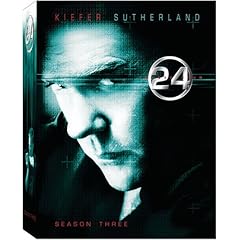
24 - Season 3

Jack Bauer's crazy life continues with yet another huge crisis in Los Angeles that will somehow be averted in exactly 24 hours. The stakes are higher than ever, as the entire country is in danger from a specially engineered virus that kills 90% of all exposed to it in less than a day. This season is a little trickier than the others, as all is not as it seems in the beginning, and it turns out the entire first half is a bit of a waste of time. There's a whole lot of trouble going on in Mexico, and some important stuff happens there, but the actual danger isn't coming from south of the border.
The third season is darker and more depressing than previous ones. Way more innocents meet an untimely end, and at times it can seem a bit cynical. They'll show images of people suffering, basically saying "Look at this, isn't this sad?" It does help raise the stakes though, as it has the best tension so far despite fewer shootouts in dark alleys. Near the end, a character gets captured and someone close to them is forced to act against their allies, and while that is playing out, I was on edge the entire time. Very few things have kept me worried for so long, so overall it was a very successful story despite continued permeation of people who just seem to ignore simple solutions to their problems.
Jack's having more problems, as he has to save America while dealing with heroin withdrawal after getting addicted to maintain his cover. He seems more human, while still being a very strong protagonist. Kim's back, but instead of being in peril the entire time, she's actually useful for helping the good eyes, and is only in peril a little while. The president we all know and love is having problems again, this time when he gets involved in a possible scandal that could cost him his reelection bid. I understand the desire to have more than one plot thread to keep it from getting too tedious, but it's honestly never as compelling as the simple counter-terrorism battle. Fortunately, it's satisfying in the end thanks to a character I'm pretty sick of finally getting what was coming. The fourth season is a bit of a reboot with a lot of different characters in the foreground, so the third was a nice wrap up of all the threads that were created over three years of good television.