I thought that the fourth season of MI-5 was a step down from the previous one, although it still had its share of interesting episodes and good moments. I felt like they were turning to the Islamic terrorist angle a bit too often this time, since it often results in some of the least compelling stories the show has to offer, although I'd hesitate to call anything the show has done thus far truly bad. We do get the series' first true two part episode, although honestly I'm not sure the bad guys here actually deserved to see their scheme get carried across nearly two hours. Andy really, they were dipping into spy story cliches a bit too much, with things like an agent's former spouse not being dead after all and a CIA agent orchestrating an attack in England to garner support for an invasion of Iran is about as silly as they've gotten thus far. On the other hand, a lot of the nitty gritty espionage stuff was as cool as ever, and the cliffhanging season finale involving a possible conspiracy around Princess Diana's death and a particularly well equipped nemesis is possibly the most fun I've had with the whole show so far. I've gotten a bit more used to the transience of the cast at this point, and I think it sort of works both for and against the show. The willingness of the writers to write out or even kill off central characters makes the stakes high in every episode and has resulted in some strong drama, but with how frequently it's been happening, it also makes it more difficult to become too attached to a character when you know how easily they could be replaced. It stunts character development just a bit when the people who get the most screen time are the most likely to leave, too. Still, the show has balls, and that's a good thing.
Tuesday, November 30, 2010
MI-5 - Season 4
Monday, November 29, 2010
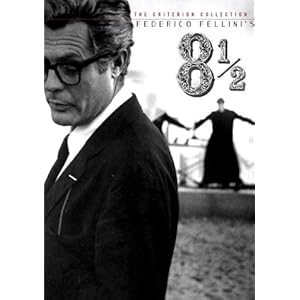
8 1/2

Famed Italian director Federico Fellini's most celebrated work is unfortunately not one that I can say I truly enjoyed all that much. It's a well-made film with a lot of thought, creativity, and inventiveness crammed into its two hours of meandering story, but at times I found actually watching it more of a struggle than a classic should be. There was obviously a lot of talent involved in making it, it just wasn't a movie that was made for me. I probably would have appreciated more if I knew more about Fellini's life and career, because it's known as an especially autobiographical film, as he delves into his own mind quite a bit. But as it is, that doesn't enhance it that much for me. I guess you could say it's about as watchable as an Italian expressionist film from the 60s could be, but it's still something that requires a lot of attention and forgiveness for certain production quirks.
It's about a film director struggling to come up with his next picture. He spends a lot of time talking with his writer and producer, meeting actors, and wondering what he will do. But while this is the focus of the plot, the film itself goes a bit deeper. There are tons of dream sequences, and they're usually interwoven with reality so before you know it you've transitioned from one to the other and back again. These scenes are often the most interesting in the film, because they shed light on the director's psychology, particularly in regard to all the women in his life, and they often have an energy that's missing in the scenes from reality. The film's score and visual sense are some of its greatest assets, with a ton of well chosen imagery and darn good cinematography for the 60s, and a mix of classical music that tends to enhance what's happening on screen. An unfortunate aspect of the way it was put together is the dialogue though, with every single line being overdubbed and often quite obviously not matching whatever the actor was saying on set. I realize that it was a choice by Fellini, but that doesn't make it less distracting, and with a movie that's basically filled to the brim with rapid dialogue as the director is bombarded with questions, it strikes me as a curious relic that I'm glad doesn't happen anymore. It's the kind of artistic movie that I think almost anybody could see the intelligence and craft in, although I think many would struggle to enjoy it as I did. Worth seeing if you love the medium, but definitely a long two hours.
Sunday, November 28, 2010
MI-5 - Season 3

Well, I was hoping that MI-5 would raise the stakes after two mostly predictable (but still good) seasons, and boy did it ever. There was a bit of turnover from season one to two, but what we have here is a massive cast overhaul over the course of the season. All three of what I'd call the main characters leave the show for various reasons by the end, and while it's a bit obvious how their niches in the ensemble are getting replaced by other actors, it was still an impressive showing that the stories in this show are more important than the comfort of seeing the same faces every week. There are still a couple guys who appeared in season one left, but they've definitely established at this point that no one is safe.
And it's not just characters leaving, the stories this season were really damn good as well, several easily among the best in the series. The cliffhanger had much more immediacy than last time, and the whole first episode was dedicated to resolving one of the better schemes the show has cooked up. It also had two outstanding, emotionally powerful episodes back to back dealing with Danny's struggles to commit his first assassination and the political fallout for Zoe of an undercover operation that goes wrong. This is definitely not the typical glamorous pop culture spy life getting depicted here, things get dirty and they're hard on everyone involved. Even more typical missions seemed to have more weight than before, with complex character drama woven in to make the guest stars more than just a recognizable face. I mean, I haven't even been watching the show for that long, but I definitely have more confidence in it making good use of appearances by guys like Gollum and Palpatine going forward than most others. And while the season didn't end with a cliffhanger like the first two times, that's actually a good thing, because the episode itself didn't need it and was again a pretty damn great hour of drama and action. I like this series a lot.
Saturday, November 27, 2010
Stand By Me

Stand By Me is another one of those movies I've seen chunks of but never sat down and watched until now. And it's good! Rob Reiner knew how to direct mature movies that would be interesting to people of many different ages. It takes place mostly at the end of the 50s, but it still has a timeless quality that should remind anyone of summer vacations spending time with friends, especially if they lived in a rural area. The main character is Gordie, played by Wil Wheaton as a kid a couple years before Star Trek: The Next Generation and Richard Dreyfuss as an adult and the narrator. After learning that his childhood friend was killed in a restaurant, he decides to write down the story of a watershed moment from his youth, where he and his buddies walked through miles and miles of countryside to find the body of a local boy who's been missing.
The other three friends are played by River Phoenix, Corey Feldman, and Jerry O'Connell, and while they tend to be more famous for why they don't have careers than the careers themselves, it's remarkable how they're all still recognizable names 24 years later. I don't think that usually happens with kid actors. The older teenager characters are occasionally recognizable too, with Kiefer Sutherland playing the biggest jerk in town and antagonist and John Cusack in flashbacks as Gordie's deceased older brother, and the only one in his family who seems to care about him. Everybody does a pretty good job, and it's noteworthy how the kids all manage to act like real twelve-year-olds without getting annoying.
So it's sort of like a small-scale road movie as they wander along train tracks, over bridges, and through forests looking for where one of them heard his older brother describe the body's location. Their relationships are as realistic as you'll see when it comes to adolescent American males, always poking fun at each other and sometimes getting violent, but obviously still affectionate and understanding. O'Connell doesn't really get an opportunity to be dramatic, but the other three all have moments of vulnerability that bring them closer together as they use the body as a goal to get through their troubles. The movie is often funny and touching when it wants to be, and while the story sort of sweeps some of the difficulties under the rug by the end, it's still a good story and a definite piece of Americana. Apparently the Stephen King story that this was based on was quite a bit harsher, but the movie didn't need to be to work.