Life goes on, and I continue to watch a number of films that I have never seen before. I'm running out of "classics" in the instant queue at this point, and I don't know if I'm going to keep that when Netflix switches up the plans in a couple months. But I'll keep watching movies. 11B goes up tomorrow.
The Conversation
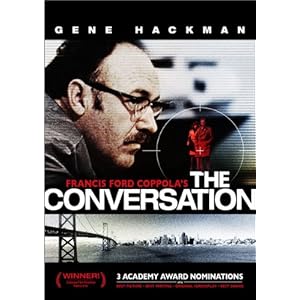
Sandwiched between the first two parts of The Godfather, Francis Ford Coppola made this film, a much more intimate and inward-looking affair. Gene Hackman does a great job (I find it amazing he was already 44 when this was made, but I hadn't realized he retired years ago either) as a surveillance expert who becomes worried by the content of a conversation he is hired to record, and reluctant to hand it over to his client. He's surrounded by a great cast, notably a young Harrison Ford as his main contact with the client, John Cazale as his spurned partner, and a brief appearance by Robert Duvall. It's mostly a character piece, and the script and Hackman's work do a great job of bringing a quiet by interesting man to life. Things do get hairier later on, with some surprisingly shocking moments as it reaches the climax. Nice anti-Hollywood ending, too.
The Hustler
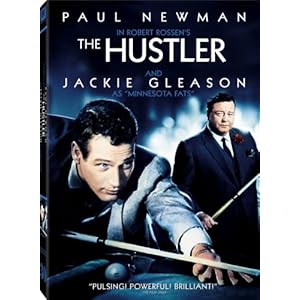
I feel like Paul Newman was sort of a singular talent that came into his own in the 60s, and since he didn't have any direct competitor like Robert De Niro versus Al Pacino, some people my age overlook how amazing of an actor he is. There's no ongoing debate around him, he's just an amazing actor. Could be making crap up, though. In The Hustler he plays a pool shark, and while there are extensive pool scenes in the movie, it's more about the turmoil of the character, who realizes he's not who he thought he was after a game against Jackie Gleason's Minnesota Fats goes bad. George C. Scott is also great in the movie, and it's just a fun film to watch despite some pretty dark material towards the end. The good kind of sports movie that's not really about sports.
MASH
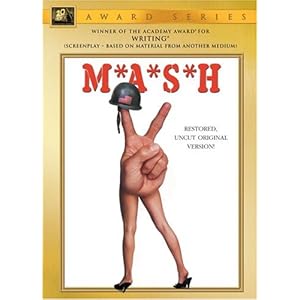
All I really knew about Robert Altman before seeing this was he made movies with ensemble casts that talked over each other, and that's certainly the case here. It's a Korean war movie that's really about the Vietnam war, and showcases funny actors rather than comedians trying to act. The three main characters are military doctors played by Donald Sutherland, Elliot Gould, and Tom Skerritt who don't care much for proper chain of command or behavior for their positions. It's not really realistic how cavalier they are with their mistreatment of other officers in the movie, but it's a satire, and it works. I didn't think it was an amazing movie, but I did enjoy watching it go through its paces, and there are a number of memorable scenes, even if some don't quite pay off or go on too long. I can definitely see how some producers looked at it and saw a way to make a series out of it, after removing some of the racier stuff. I assume I'll continue to never see it, but you never know.
Play Time
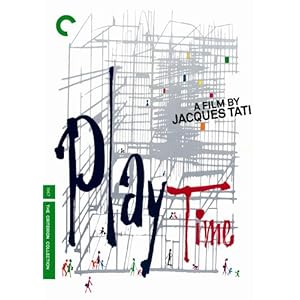
One of those movies that I didn't really love, but I appreciated the immense amount of care and craft behind. It's hard to say what Jacques Tati's deal is, beyond a lot of wide shots filled to the brim with little bits of physical comedy in every corner of the screen. Play Time is a film where dialogue isn't very important, and I could easily see the whole thing working almost as well with no subtitles at all (it's already a mix of French and English), or even as a silent film. It's about a tragic future version of Paris, where all of the famous landmarks people love have been replaced with plain buildings filled with sterile cubic offices, steel floors and chairs with squishy cushions. Humanity still shines through though, as Monsieur Hulot and an American tourist bumble around the trade shows and turn a disastrous restaurant opening into a heck of a party. I think the whole thing could have greatly benefited from chopping as much as half an hour off, but there's nothing wrong with any individual scenes. You can just only take so much whimsy and clever visual comedy before it all seems like the same stuff. Still a solid film.
Wednesday, July 20, 2011
Movie Update 11A
Monday, March 21, 2011
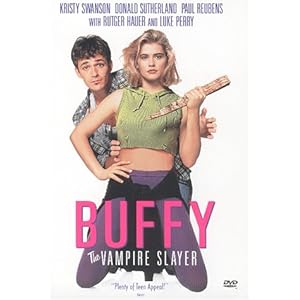
Buffy the Vampire Slayer

Buffy the Vampire Slayer is a pretty bad teen horror comedy that is notable for two reasons. Obviously, it led to the much better and more successful television series and media franchise with the same title. Also, it stars some surprisingly talented actors, and features an abnormally large number of people in bit parts who would later go on to reasonably big careers. There's a pre-multiple-Oscar-wins Hilary Swank as a vapid high schooler, a pre-being-more-famous-than-he-should-be David Arquette as a punk-turned-vampire, and even a pre-Good-Will-Hunting Ben Affleck as a basketball player with one line. There's an early Stephen Root performance as a school administrator, and Thomas Jane apparently played someone named Zeph. Paul Reubens and Rutger Hauer play powerful vampires, Luke Perry found time to play a deadbeat who finds himself thrust into the sidekick/love interest role while he wasn't filming 90210, and Donald Sutherland is Merrick, a Watcher like Giles who is immortal for some reason. Star Kristy Swanson is practically the least currently famous person in the cast.
But anyway, I'm getting away from the movie, which was not very good. The script is credited to Joss Whedon, and while apparently several changes were made, I read the comic that was based on the same script, and a whole lot of it is the same, particularly the dialogue. The fact that the film is so amazingly unfunny despite using a lot of the same lines as the decent comic further proves something that was revealed in Alien Resurrection - as fun as Whedon's dialogue can be, in the hands of the wrong director and cast, it can be disastrous. Without the right attitude, it comes off pretty awkwardly, much more like somebody reading a script than talking. With the right talent it shines, but otherwise it can be bad. Buffy is the only character shared between the movie and show, and Swanson's interpretation just doesn't work. She's a pretty blond, but that's pretty much the extent of her similarity to Sarah Michelle Gellar's version. Buffy begins the series as a fairly normal teenage girl, but there's always that snarky undercurrent that kept her interesting right from the start, and the Buffy here is just too much the stereotypical popular high school student. Reading the comic in the show's voice showed how the material could have worked fine, but they just go another way with it that fails.
And with the dialogue failing so badly, a lot of the comedy gets shifted to the physical side of the movie, which just doesn't work either. There's a certain cheesiness to the martial arts action on the show, with some obvious stunt doubling and overly elaborate movement for simple results, but the tone makes it seem like an old action movie rather than a big joke, which is what it is here. There's hardly any real fighting at all - Buffy does some flips and hand springs and a limited bag of tricks, but any time there's actual physical scuffling it's just incompetent. Reubens' character was probably supposed to be intimidating, but it doesn't work because he's god damn Pee Wee Herman, and the best we get out of him is a weird piece of anti-comedy where he is apparently killed by repeatedly fails to actually die. Hauer's character's evilness is also told more than it's really shown, and the role is a major waste of his innate menace as an actor. And the changes made to Merrick and what the Watchers are for the movie add up to a whole lot of nothing.
I watched it because I wanted to see the background of what causes Buffy to move to Sunnydale and let the series begin, but some cuts to the script remove a couple pivotal events anyway, and the few people besides Buffy who are mentioned in the series that appear aren't really the same characters, so it doesn't serve that purpose well. It was pretty much just a waste of my time, even if the movie was shorter than a two-part episode of the show. There are no real likable characters, it's not funny, it's not scary, it's not exciting. And it's not capable of building an ironic cult following because something that was actually good grew out of it. All it can be now is a curio for fans of the series. Without Fran Rubel Kuzui the Buffy franchise probably wouldn't exist, and she deserves some credit for that. But the film she actually made was poor.
Thursday, September 16, 2010
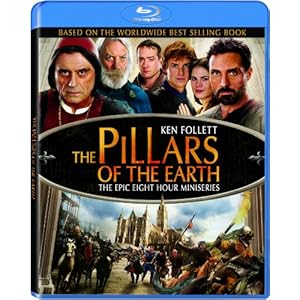
The Pillars of the Earth

Pillars is a miniseries based on a British historical fiction novel, and plays like a half decent representation of what the Game of Thrones series will probably be like. It's about the creation of the fictional Kingsbridge Cathedral, set against the actual reign of King Stephen during the 1100s. A Cathedral already being an incredible undertaking back then, construction is beset by complications arising from the dispute over the throne and the ambition of a noble family and a bishop played by Ian McShane, who is more or less the story's main villain. There are a couple other notable recognizable faces, including Donald Sutherland, who gets credited in every episode despite only appearing in a couple, and Hayley Atwell who stood out in the remake of The Prisoner that aired last year and does again here as the daughter of a fallen Earl.
So the show is a mix of a very human story mostly focusing on the family that guides the building of the Cathedral, endless political maneuverings and backstabbing, and some decently filmed (for television) battles. The latter two tended to interest me more, although it's hard to ignore what is really the emotional core of the story. The good guys are mostly likable and the bad guys are pretty easy to hate, although I will say it's harder than it should be to really be against Ian McShane whatever he's doing, so good is he at every role he seems to take.
There are a few plot bits that are pretty annoying, but overall it's a solid tale, and pretty damn well paced for about eight hours of content. One thing that always kind of bothered me was the passage of time though. The timeline lurches forward in fits and starts, sometimes months or years at a time, and by the end I was unsure about how much time things took. And it never seemed like the right amount of effort was put into portraying the ages of the characters. Young characters aren't recast often as they get older so they stay looking too young, or just disappear from the plot. And most of the other characters don't age much as the years pass by, until something gets triggered and suddenly the next time you see them they're in full-on old person makeup. It's a bit clumsy, and maybe something of a budget concern, but it doesn't hurt the story too much. Anyone interested in some medieval history portrayed in perhaps a less than historical way should probably give it a shot.
Thursday, September 3, 2009
The Dirty Dozen

I know Inglourious Basterds got to me because I keep watching old movies that are somehow related. Dozen is a popular sixties movie with a similar premise on the surface, an officer training a group of ragtag soldiers for a special purpose during World War II. In this case, Lee Marvin is given twelve soldiers condemned to hard labor, prison, or execution and what amounts to a suicide mission to kill as many Nazi officials as possible holed up in a chateau on the eve of D-Day. Most of the movie is just Marvin training the soldiers into a cohesive unit while they occasionally rebel against perceived injustices, but eventually they get to the surprisingly violent climax.
Just like the Basterds, most but not all of the Dozen get significant character development. Charles Bronson is a former officer and the old hand of the group, almost a secondary leader. It's funny how he has the hard reputation and when they do the lineup by height, he's the fourth shortest. Donald Sutherland has an early role as Pinkley, who's a bit dimwitted, but ends up being one of the more likable characters. Other ones that stick out are the big guy, the black guy, the rebellious guy, the short guy with the moustache, and the crazy one. Ernest Borgnine is also the general in charge of the operation, and he's pretty much the same dude he still is today. It takes a while, but eventually the Dirty Dozen (so named because of their refusal to bathe or shave with cold water) gel into a cohesive whole, proven when they win a training exercise through unconventional means.
Then they drop into France, and the tone shifts rather dramatically. The carefully orchestrated mission has a couple slip-ups but still stays on course until someone screws it up big time (guess who!), when things turn into a bloodbath. It's a pretty large scaled and impressive action sequence for the time, although there were a couple situations where it was less than obvious that certain characters died and I just had to assume they did later when they didn't show up. Their Plan B to take out as many Nazis as possible is surprisingly brutal for the time, and honestly made me a little uncomfortable with the whole thing. But I guess the whole point of movies like these is to show how hellish war can be. The conclusion isn't exactly satisfying, but it's what you might expect from a cynical movie like this. I was pretty impressed overall.