Showing posts with label Harry Dean Stanton. Show all posts

Saturday, November 19, 2011

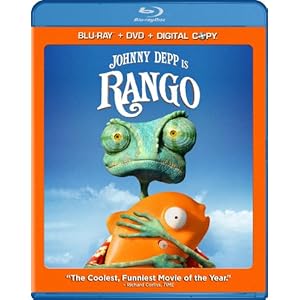
Rango


I had heard that Rango was a good animated movie for people besides little kids, but I didn't expect to like it as much as I did. It's probably the best non-Pixar American animated movie I've seen since The Iron Giant, which is a lot of qualifications, but it's still a solid accomplishment. It's definitely not a movie designed to appeal directly to children; I'm sure plenty would like it, but the story and characters have enough maturity and older-skewing references built into them to make it probably appeal more directly to someone with at least more knowledge of the history of film. There's a lot of Western character archetypes and homages to a bunch of different sources, the stuff that's supposed to be fun for parents who brought their kid to the theater. It goes beyond that here, though. The whole movie seems more designed with the parent in mind than the kid.

Again, not that I don't think kids would like it at all. It's a pretty silly movie in places, and not very difficult to follow. I just thought it was aimed at me more than I expected it to be. The cast is pretty outstanding and varied, with the right idea being used when the voices were picked - they do use celebrities you've heard of, but they're cast to play characters, not to be famous and recognizable. I know Johnny Depp at least was moving around on a set to help create the character, and his Rango is pretty loveable. He's a pet iguana who ends up stranded in the desert and meets up with a small community of wild animals who are struggling to find water. There's a love interest played by Isla Fisher, and a cute little girl played by Abigail Breslin, and a wise but suspicious authority figure played by Ned Beatty. It could pretty much have been a live action Western with the same general characters and worked the same, and that's what's interesting about it. The animation enhances the movie though, providing great opportunities for little moments of humor and some pretty spectacular action sequences. There's just something about complete freedom and control of moments of excitement that really brings out the potential of the form. It's kind of a simple and predictable story, but it works because of the solid humor and charming cast. I certainly wouldn't mind seeing it dethroning Pixar in the Best Animated Feature race early next year.

Tuesday, April 5, 2011

Twin Peaks: Fire Walk with Me


David Lynch's unique style and direction make this movie enjoyable, though it's certainly a flawed one. People who haven't seen the show either won't understand at all what's going on or find what they do understand to be unsatisfying, and people who have seen the show will probably be disappointed by some of the things from the show's central appeal that are missing, and might find the material that is there a bit too well-worn to be really compelling. It was a project that was probably doomed to fail, though it was nice to visit the town that made the show such a joy one more time.

Fire Walk with Me is a prequel to the series that shows the initial investigation of Teresa Banks' murder and the events of the last few days of Laura Palmer's life, while also filling in a little bit about Agent Cooper's introduction to the case and what happened after the series finale. It begins with another pair of agents investigating Teresa's death, and after one disappears (the other is played by an enjoyably quirky Kiefer Sutherland), Cooper is put on the case. Before long though he hits a dead end, and the focus shifts to Laura's story, which takes up most of the movie. Here we see a whole lot more of the depravity and weird mumbo jumbo that made up the circumstances around her death, the former of which we mostly already knew about and the latter of which still doesn't make a whole lot of sense. Laura does drugs, ignores her friends, prostitutes herself, and becomes increasingly erratic as she learns more about the strange man who's been tormenting her. Eventually things spiral out of control as we see what really happened the night before the series starts.

None of the details are too unexpected though, and at times Fire Walk with Me feels less like a movie filling in gaps and more like a mythology-heavy flashback episode that the show never ended up really needing. Lots of characters return, mostly played by the same actors, although too often little is done with them besides reminding the viewer of little things. Hey, remember how Laura did Meals on Wheels with the diner? Or how Bobby scored coke for her? Now you get to watch it. I don't object to seeing the world of Twin Peaks expanded, I just wish that the movie had more of a point to it. I also wish it was a bit closer to the tone of the show. Twin Peaks had adult themes but was acceptable enough for prime time television in the early 90s, while the movie really earns its R rating with swearing, violence, and nudity. This would be fine, but the dark aspects of the film end up taking over the whole story, and the other side of the series, the goofy, charming side, is pretty much entirely abandoned after a certain point.

So I think the film is worth watching if you really loved the show, and would like to see more about the key events that shaped it in the beginning. It's actually a reasonably effective horror movie, an element that the series touched on but never really embraced. It doesn't really go out of its way to terrify you, but there's lots of spooky and creepy imagery, especially revolving around all the mystical stuff, and the last act of the movie in particular is brutal and uncomfortable to watch. Lynch has a handle on film making even when the material isn't top notch, and in saying goodbye to the show he loved but didn't completely deliver on, he made a reasonably entertaining movie. I know a lot of people really hated it, but if you go in knowing the limitations and what you're in for, I think it's worth seeing.

Thursday, December 30, 2010

Cool Hand Luke


Like a lot of prison movies, Cool Hand Luke relies on the quality of the craftsmanship on the screen more than the events that drive the story. Not a whole lot happens in the plot, but it still sustains itself well for two hours thanks to skillful direction by Stuart Rosenberg and a good, restrained performance by Paul Newman. George Kennedy acquits himself well in an Oscar winning performance as Dragline, and the rest of the cast is solid as well. But it's Newman's performance I'll remember the best, doing a great job holding up the character end of a character-focused story. He can be the coolest guy in the room in one scene and a broken-down mess in the next, and while his journey can be depressing, on the other hand it's also an example of how the human spirit can never truly be broken, and in a way it's about how legends are made.

Luke is a war hero who seems bored with life, and gets arrested and sentenced to two years in a Southern work prison when he gets caught drunkenly cutting the heads off parking meters. Dragline is a leader among the inmates, and at first the two butt heads. But eventually they bond when Dragline is impressed by Luke's refusal to ever give in, and gives him his Cool Hand nickname after a poker game. Things go pretty well for Luke considering the prison setting for a while, but after a tragedy, he is unfairly punished and becomes rebellious, repeatedly trying to break out of the place, which results in some pretty harsh treatment. The transformation of the character is the meat of the whole movie, and while it's often difficult to see it's always compelling as well. The movie is also famous for some of its dialogue, like the prisoners telling the guards about everything they're doing and the "failure to communicate" line, and those things were entertaining to see, but what most impressed me about the film is just the amount of care that went into making it. Prison is usually a good way to examine the psychology of men, and Cool Hand Luke is as good an exploration as any. It's not my favorite, but it's darn good.

Thursday, December 2, 2010

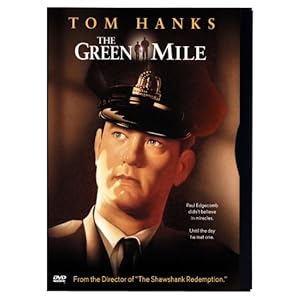
The Green Mile


The Green Mile is a good movie trying very hard to be a great one. It's Frank Darabont's second film from the 90s, and like The Shawshank Redemption, it is a period drama set mostly in a prison in early 20th century America, featuring a bond that forms between a white man and a black man, and based on a story by Stephen King. It also features a strong cast, and is undeniably well made even if you don't like the story. The film has an extremely stately pace and feel, almost to excess, and tugs very hard on your emotions, although it's not quite the same as Shawshank. One of the biggest reasons is that the plot actually has a supernatural element, one that would actually qualify the film as a kind of fantasy story, and one that I imagine would greatly surprise anyone who came into watching it blind, especially since this element doesn't actually surface until a full hour into the film. A lot of things are like that though, since it's three hours long when the story seems like it could have been told in two. I wouldn't say it was too long exactly, or that it ever really got boring, I just don't see what the benefit was to giving every single bit of story as much time as the producers would physically allow to develop.

So Tom Hanks is in charge of death row at a prison. Most of the prisoners are decent guys who did wrong, but the two that get brought in after the movie begins are different. Michael Clarke Duncan is a saintly giant, the ultimate version of the magical negro. Sam Rockwell is a deranged, freakish bastard. Hanks is the boss of several recognizable faces as the other guards, who are mostly good men like he is, except for Doug Hutchison's character, a privileged piece of shit with family connections who wants to watch a couple crooks fry before transferring to a better paying job. Sam Cromwell plays the warden, and Patricia Clarkson is his wife dying of a brain tumor. Those are pretty much all the pieces that will be shuffled around, as the guards learn more about Duncan's abilities and realize why he ended up getting sentenced to death for the rape and murder of two young girls. The acting is good all around, especially the two leads, with Hanks' weariness over what his job is doing to him and Duncan's otherworldly innocence, despite the stereotypical nature of the character. It really is a well produced film, and I liked the mixture of fantasy bits with an old fashioned southern drama. But it seems like the kind of thing I'd struggle mightily to ever watch again, and the whole movie is quite possibly just a bit up its own ass. Still, I liked it.

Thursday, September 9, 2010

The Godfather: Part II


The Godfather might be the best made film I've ever seen, and the sequel does plenty to live up to that standard of cinematography, editing, and acting. I don't think it's an insult to say it doesn't quite live up the the original's standard of storytelling, because it's still an outstanding film and that's a hell of a thing to live up to. I had no issue with any individual element of the movie, I just don't think the overall character arc is quite as fascinating as in the first. In Part I, Michael Corleone is a war hero who slowly gets sucked into his family's criminal business due to loyalty to his father and a decade of desensitization to the wrongs he's committing. He eventually finds himself as don of the whole family. It's a transformation that's fascinating to watch. in Part II, Michael's the godfather. And he's the godfather for the whole movie. Lots of interesting stuff happens to his character, including some pretty brutal personal things in the second half. But while he descends deeper into the role of ruthless crime lord, the arc is just less distinct. It felt more like watching a few episodes of a brilliant crime show than a self contained, fulfilling story.

Again, I don't want to undersell how good this film is. It's one of the best of the decade. It just didn't quite match the first, to me. There's a lot going on, and it's definitely a movie that gets better the closer attention you pay to it. Bit characters from the first film show up to play important parts, there's a dense web of deception and backstabbing that's quite a bit of work to keep up with, and it's as interesting a straight gangster tale as I've ever seen. The flashback segments featuring Robert De Niro as a young Vito Corleone, depicting his rise to power in 1920s New York, are pretty brilliant, and I might have gotten more out of the film as a whole if they got a bigger share of the 200 minutes rather than feeling like a distinct B story to the main one of Michael's struggles. The mostly returning cast is brilliant, Al Pacino further proved himself to me as a master of the craft in his younger days, Robert Duvall continues to make Hagen one of the most sympathetic characters despite his somewhat thankless role, and Diane Keaton has a lot more to do this time, showing she deserved to be in several of the 70's best films. I don't really know many other actors here by name, but no one would have made it into the movie if they didn't know what they were doing. There's not much else to say about it without going into the specifics of the story, which I feel would be a disservice. I don't have to tell anyone this, but the Godfather movies deserve to be seen by anyone who likes the medium for more than just a few laughs and explosions.

Sunday, February 21, 2010

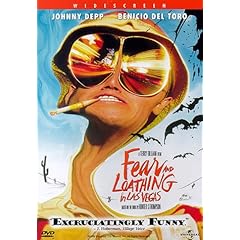
Fear and Loathing in Las Vegas


So this was a strange movie. The whole thing is practically one long drug trip as Johnny Depp and Benicio del Toro wander around Vegas hallucinating and acting crazy. It's frequently very funny, although just as often merely bizarre. I struggled to find a point to the whole thing, as it's based on a semi-autobiographical book by Hunter S. Thompson and just seems to be a snippet of one of the crazier times in his life. Based on a few old interviews I've seen, Depp's portrayal of the fictionalized version of Thompson was pretty spot on, although with some extra flair on some things like the odd way he walks everywhere while tripping. There's a lot of brief appearances by recognizable people sprinkled around, like Cameron Diaz and Christina Ricci. I got the sense that they enjoyed making the movie, although in practice it's not as fun to watch. I liked a lot of it for the most part, but in general it was just a bit too intensely strange and wandering for my taste. For some reason del Toro's always been a bit of an enigma to me. He plays a lot of interesting parts and does unique things with them, but I rarely think of his performances as truly great or memorable. He gained a lot of weight for this part and has his moments (I love how he couched all his advice with the "as your attorney" bit, even when it had no relevance whatsoever), but in the end I struggled to find a point to his presence. Sort of like the whole movie I guess. I like Terry Gilliam as a guy, but so far I've yet to see his style really make a whole movie work. This was interesting but flawed, and I thought 12 Monkeys was held back a bit. He's allowed to keep trying, though.

Thursday, October 29, 2009

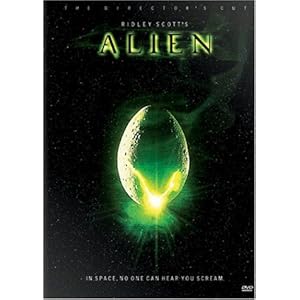
Alien


So uh... yeah. This movie. It was good, especially for its time. Around then, Star Wars was all the rage, but Alien ignores it for a view of space travel that is much more gritty and uninviting. The crew has to go into a frozen sleep because of the length of the journey, and the ship looks like it was made out of pieces of a refinery somewhere. It's kind of silly now that all of the computers lack anything close to modern interfaces (and even sillier that the sequels don't change it, I understand wanting to be consistent, but with the time passing between the movies there's plenty of justification for an upgrade), but it does contribute to the atmosphere. The movie is a slow burn, as plenty of time passes just establishing the crew and mission before anything goes wrong, and even when it does, it takes its time getting really bad.

There aren't many people left who don't know how the alien gets on the ship, although the entire sequence of events remain interesting and disturbing to watch. I can't say I got the same thrill when I knew exactly what was going to happen at certain points, but I still appreciated the craft at work. As I've said before, Ridley Scott is a man who knows how to shoot a scene. Once the alien gets loose in the ship it becomes more of a standard horror movie, with fake-out jump scares, bad decisions (Hey I know there's a monster on the ship trying to pick us off one by one but we just decided to go make you find the cat by yourself), and brief glimpses of the killer as it makes quick work of the people on board. The only disappointment was the alien itself. They went through great pains to make it not appear to be a man in a suit, but it's totally a man in a suit, and most of the kills are too quick and confusing to totally appreciate what's happening. By the end it's just Sigourney Weaver who remains, and she has a chance to creep around in her underwear for a bit before destroying the creature and the ship, and going back to sleep intact for a sequel. Scott originally wanted to kill her off in the end I think, but her character of Ripley is the one common thread through the series (besides the aliens obviously), and at least for a while it seems to have been a good decision.