Showing posts with label Samuel Jackson. Show all posts

Thursday, September 15, 2011

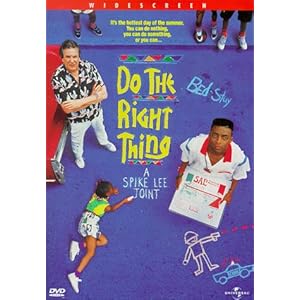
Do the Right Thing


What was most interesting to me about this movie is that there were two sides to it, but they blended together extremely fluidly. It's sort of a comedy about every day life in the city, but it's also a searing, controversial drama about race. It seems like these aspects might not work well together, but they really do. This is only the second Spike Lee film I've seen so I can't really say a ton about him, but he does seem to have some interesting ideas.

The movie takes place mostly during a single, extremely hot day in Brooklyn. Lee plays Mookie, who has a sister he lives with, an extremely boisterous girlfriend played by Rosie Perez (and who dances in the opening credit sequence, which is so iconic that I recognized it instantly despite not having seen it before), and works at an Italian-owned pizza restaurant as a delivery boy. He goes about his day, delivering pizzas, avoiding the heat, and bumping into a number of the neighborhood eccentrics that surround him. A bit of tension, driven by the heat, slowly starts to boil as a couple people start to butt heads with Danny Aiello's Sal, the restaurant's owner. One is Buggin' Out, who takes issue with the fact that the place's "wall of fame" is populated exclusively by Italians, and who is played by Giancarlo Esposito, in a performance that is absolutely fascinating watching him play the endless calm and calculating Gus Fring on Breaking Bad. The other is Radio Raheem, who carries around a huge boom box blasting "Fight the Power", and who just seems to not like most people.

The movie goes along, introducing and spending time with its various characters, like John Turturro's Pino, the son of Sal, who's a racist but also hypocritical about it (he loves Eddie Murphy and Magic Johnson but justifies it by saying they're "not really black"), and Love Daddy, a fast-talking radio DJ who sort of acts as a narrator and is played by Samuel L. Jackson. Eventually though, the simmering tension comes to a head, in a series of events that unfold surprisingly quickly change the entire mood of the film. Mookie does something that has been much debated over time, but only really by white people. It's an act of violence that causes a full-on riot, but it also probably saved some people's lives. The movie's called "Do the Right Thing", and I think that he does, but the movie's not about supplying simple answers to complicated questions about race. The types of events that caused Lee to write the movie in the first place don't happen as often as they used to, but as long as they continue to occur anywhere, it's the kind of movie that people should be watching, if only to make them think a little bit.

Tuesday, July 26, 2011

Captain America: The First Avenger


Sometimes you see a movie that makes you forget what the point of the medium is. Are people actually trying to tell stories? Or do they only ever get made to make money. It's probably somewhere in the middle for everything, and of course certain films have more artistic purpose to them than others. At first, this whole Marvel project leading up to next year's The Avengers was exciting, and it didn't interfere much with the movies themselves. Iron Man and The Incredible Hulk were pretty much regular super hero movies, which happened to include a scene teasing the eventual conclusion of the undertaking. Last year with Iron Man 2 though, the Avengers subplot grew visibly, leading some to think the movie was overstuffed and aimless (I still liked it). And this year with Thor and now Captain America, we're actually seeing hints of what the plot might actually be about, as the project threatens to wipe out any individual accomplishments of the other movies by themselves. Captain America's whole plot was probably adversely affected by The Avengers, as they had to turn Steve Rogers into a superhuman, get him through the war, and then have him wake up in the modern day within two hours. When all is said and done, will this whole thing actually be looked back on as a major triumph of long-term genre filmmaking? Or is just a way to make a lot of money, as you hype up a big event film and then hook people into buying tickets for a bunch of other movies in the lead up to it?

The real question though, is whether people care. I don't think I do. I think most people today are content to have their summer action movies be loud and colorful, and as far as that kind of movie goes, Captain America is more than adequate. It's not perfect, but I enjoyed myself while I was watching it about as much as most big action movies I've seen, assuming we aren't talking about ones with actual inspiration and creative intent behind them. And that's totally fine. Joe Johnston hasn't had the most distinguished career, but he knows what he's doing, and he manages to shoot this film with a nice traditional style and keep the action mostly coherent without an over-reliance on special effects (though things like Chris Evans' face on a scrawny body or him running with super speed sometimes definitely look silly). Evans is totally adequate as Rogers, both as a nobody and as a hero. The problem here is that Evans' best asset is that he's charming, and his character isn't really allowed to be. He's awkward and duty-driven and righteous. I still think he's likable enough to hang a movie on though, especially when the supporting cast is as helpful as this one.

As always, Hugo Weaving does an excellent job in a genre role, playing the villainous Red Skull with a solid German accent and a real menage. Tommy Lee Jones' character is sort of a standard gruff military leader, but he's Tommy Lee Jones and the part works out really well. I especially liked his interrogation scene. A couple TV actors who have done solid work there get a bit of big screen time here, including Hayley Atwell, who's a good romantic foil for Evans and has a look that fits in with the image of beauty for the period, and Sebastian Stan who brings life to Bucky Barnes in an enjoyable way. Stanley Tucci is a lot of fun in a few brief scenes as the inventor of the super serum, and I just loved the image of Neal McDonough with a big mustache and a shotgun as Dum Dum Dugan. Put it all together and you have a nice, brisk World War II movie, which happens to feature a legendary cube of immeasurable power, anachronistically powerful technology, and a guy running around with the world's best shield.

The biggest issue I had with the film is that the structure of the story feels wrong. It's not a huge deal because it's just a popcorn flick and most of the individual scenes hold together well, but it's definitely noticeable. Not every story has to adhere to the standard three act structure, of course, but if they don't the structure they use instead should be clear. The problem with Captain America is that it still seems like a three act movie, it just forgot the second one. It takes a long time for Steve Rogers to become the man we know. First he has to be given a chance to join the military, then he has to be selected for the super serum test, then he has to prove he can be a soldier with it, and then he has to establish a goal for the rest of the film. Meanwhile, we're also setting up the Red Skull and what his goal is to win the war. This is all stuff that the film tries to stuff into what should be the first act, and it takes over an hour. By the time it's all done, the script seems to realize there isn't time to tell a proper story, so they stuff a lot of implied action into a slick but unsatisfying montage, and then proceed quickly to the proper third act. It's just sort of sloppy.

I think if less time was spent between Steve getting his powers and proving his worth as a soldier, things would have been smoother. There's this whole section where he's being used for propaganda which is amusing on its own, but drags down the pace of the story in retrospect. It wouldn't have taken that much to fix the whole thing, which makes the problem kind of irritating, but like I said, being as the film only really exists to pump people up for The Avengers and sell tickets, it's not a major one. I just wonder what a Captain America movie that existed only for itself would have been like, because I think there's plenty of potential for one. I'm curious if all the planned post-Avengers sequels will be allowed to do their own thing, or if they'll just be serving to build up a sequel to The Avengers itself.

Saturday, May 7, 2011

Thor


The truth is, Thor is kind of a silly premise for a movie, and it's a bit difficult to reconcile it with the rest of the Avengers project. Marvel characters in general, at least the most famous ones, all have fantastical origins, but at least they're based in some sort of scientific premise. Spider-Man, the Hulk, and the Fantastic Four were all hit by some sort of radiation. The X-Men mutated. Iron Man uses amazingly advanced technology. But Thor is literally a god or god-like being from another dimension. He's part of the grander, weirder, more out-there side of the Marvel tapestry, a side that has gone mostly ignored in major films to this point. I liked the few Thor comics I've read and have high hopes for The Avengers next year, so I was hoping Kenneth Branagh and his cast could pull off some pretty difficult material reasonably well, and I was satisfied by the results. Thor isn't exactly great, but it's a lot of fun, and considering the degree of difficulty one of the most successful comic book super hero adaptations to date.

The key to Thor's success is that it's funny. With the figures of an ancient mythology transformed into extradimensional aliens who wear science fiction plate armor and ride rainbow bridge lightning bolts to other worlds, the whole thing could have failed just by being too silly. But there's a lot of humor intentionally injected into the story, which allows a lot of the goofier moments to slide on by and just be part of the fun. If the movie took itself too seriously, it could have been a disaster, but the tone is just right to get away with it. Most of the significant characters get a chance to tell a joke or two, and while a few moments still come off as funny without trying, they don't do much to harm the story.

The film jumps back and forth between two locations: Asgard, where Thor's allies try to unravel Loki's plot to overthrow him, and a small town in New Mexico where Thor meets a trio of scientists and tries to recover his lost powers. I enjoyed the New Mexico side of the movie more, because that's where most of the fun was, including a lot of solid fish-out-of-water humor and an exciting confrontation with the intimidating and well-executed Destroyer. Chris Hemsworth is surprisingly outstanding as Thor, pulling off his entitled arrogance without making himself unlikable, and gradually realizing what it takes to truly be noble. It's obvious he wasn't cast only because of his looks. The scientists are played by Natalie Portman, Stellan Skarsgård, and Kat Dennings, and the group dynamic between all four is pretty fun. The romance angle seems a bit forced because of the short time scale the story is operating on, but it works out okay because Portman and Hemsworth make a good team. Thor struggling to understand human society is probably the best part of the movie, and I could have sat through a lot more of that.

On Asgard, the movie is more like a slightly stranger version of The Lord of the Rings. There's a power struggle between Thor and Tom Hiddleston's Loki, as they both wish to prove to Odin, played with enthusiasm by Anthony Hopkins, that they are fit for rule once he steps down. Thor fights a bunch of frost giants with Sif and the Warriors Three, Idris Elba's Heimdall is a complete bad-ass, and the movie's version of Loki's plotting and realization of his past is fairly interesting. The two sides of the movie come together near the end as the action climaxes and Thor ends up back where he was, but of course with a tease that he'll return next year. There's a decent amount of legwork done to continue the set up for The Avengers, both as part of the central plot as SHIELD sets up camp around Thor's immovable hammer and in the requisite tease after the credits. Nick Fury and Hawkeye make cameos, and we learn what classic doohicky will prove important down the road. I thought the movie integrated the overarching stuff with its own plot better than say, Iron Man 2 did, and while the visual effects and action weren't amazing, they were adequate enough. The real strength here is the cast, and the film worked best when the focus was on the actors instead of the more fantastical stuff, which was okay but got in the way just a bit. And now we're only a couple months away from the next step in this crazy journey.

Sunday, March 20, 2011

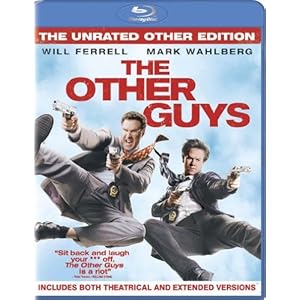
The Other Guys


Will Ferrell and director Adam McKay continue their fruitful partnership of serviceable and occasionally brilliant but often flawed comedies with The Other Guys, a send up of buddy cop movies (which are themselves already pretty silly in nature) with an odd sense of humor and an even odder political stance against the seedy nature of big money in America. The bad guys in the story are basically using fraud to cover up losses, and the entire end credits of the film feature animated information about things like how Ponzi schemes work and the average salaries of CEOs in comparison to regular workers over time. This is probably the wrong movie to throw an issue like this into, though I appreciate the effort.

The movie starts out bombastically with a ridiculous car chase through New York City as Dwayne Johnson and Samuel L. Jackson attempt to stop some drug dealers. It's one of the most wonderfully absurd action scenes played for laughs I've seen, and it's a great start for the movie. I would watch a whole film about Johnson and Jackson as these superhero cop characters. But it's not about them, it's about the other guys, played by Will Ferrell and Mark Wahlberg. Ferrell plays a number cruncher and paperwork doer who'd rather stay in the office than chase bad guys, and Wahlberg was a promising young cop who had his career derailed after he shot a famous athlete. They're mostly the subject of ridicule, but they see an opportunity to make a big case after they arrest a businessman played by Steve Coogan and he is then kidnapped by armed thugs. People with money don't like Ferrell and Wahlberg sniffing around their affairs, and they are harassed at every turn by their fellow cops and other things working against them.

The structure of the story could have pretty much just been a regular buddy cop movie, but it's the specific weirdness of the situations and dialogue that make it a Will Ferrell comedy. The film just comes up with a ton of running gags and lets them ride, and some of them end up being pretty funny. Some of the better ones include all the horrible things that happen to the interior of Ferrell's Prius, his dark past, and Wahlberg's habit of studying fine arts so he can make fun of people who enjoy them. Some bits are weirder; Ferrell's innate attraction to beautiful women is cute but offset by what's basically an emotionally abusive marriage that's played for laughs.

Ferrell's mix of low key and very loud methods of being funny are in full effect and enjoyable as usual, and while I would say Wahlberg definitely isn't a natural comic actor (or a natural actor at all, really), his hit rate on one liners is generally pretty decent. Michael Keaton is great as the police captain, and his role is another I'd love to see revisited in a Rock/Jackson prequel. The movie is overstuffed to the point of bursting with recognizable comedic talent, and most of the cameos usually have at least one decent joke attached instead of just being their for their own sake. Ice-T's narration in particular is memorable. Not every joke is a success and I would have preferred a less self-serious plot, but it was a pretty fun movie.

Thursday, October 7, 2010

Die Hard with a Vengeance


With John McTiernan back in the director's chair, the series returns to its roots a bit, with a slightly more down to earth believability to John McClane's actions, as he's less about shooting everyone in sight and more concerned with figuring things out and gutting out a win. The scope of the movie itself is even bigger, as terror sweeps through all of New York City, but it has something from the first movie that the second didn't, that thing which made the first original and interesting in the first place. Anybody can make an action movie where things blow up and a foreign guy threatens people, it takes a little extra to make it as fun as this. In fact, it's pretty damn surprising that the guy who wrote the script (which wasn't originally going to be for a Die Hard movie) went on to make something as amazingly nonsensical as The Punisher. It's not the smartest thing in the world, but it's clever and funny and exciting enough to easily last through the two hours.

A lot of entertainment comes from the buddy picture quality of the story, an otherwise typical black/white dynamic when McClane gets shoved together through circumstance with an electrician from Harlem, but it's saved by the entertaining, antagonistic chemistry between Bruce Willis and Samuel L. Jackson. They're forced to team up and race around New York while solving riddles to try and prevent bombs from going off, being teased and tricked by an enjoyably evil Jeremy Irons. Eventually though they realize the bombs are just part of a much larger and more diabolical plot, and not just a simple vendetta. The two have to use all of their wits and get the crap kicked out of them just trying to keep the bad guys from winning. By the end you're as exhausted as they are, but it was worth it because it was just about as much fun as you can have seeing a movie without it really being a great one. McTiernan may be going to jail for some of the things he's done, but you can't take away that the guy knows how to make an action movie.

Saturday, May 8, 2010

Iron Man 2


So, here's the follow up to the best Marvel movie since 2004's Spider-Man 2. And conveniently, a comparison can be drawn between this and that movie's sequel. Iron Man 2 and Spider-Man 3 are both inferior to their predecessors, mainly because they add a few too many new elements to the mix when a less is more attitude probably would have been a good idea. Let's just look at the history of comic book movies, shall we? How many really benefited from having a handful of new villains instead of just a single, strong newcomer? I can't really think of any. All of the great sequels I can think of have one powerful antagonist and that's enough for any movie. I don't feel like Iron Man 2 came out as badly as the last Spider-Man, as I still enjoyed it quite a bit, but it is pretty muddled.

In the first movie, a lot of time was spent on the origin as usual, and after his initial escape from his captors, the only significant factor working against him is a bald, bearded Jeff Bridges. This time, he's dealing with Mickey Rourke's Ivan Vanko, who's a combination of a couple villains from the comics; Sam Rockwell's Jason Hammer, a rival businessman; the government coming down on him and trying to co-opt his technology; and the increasing toxicity of his own blood. Even his buddy James Rhodes is upset with him most of the time. I was skeptical about Don Cheadle taking over the part from Terrence Howard, mostly because I just don't like seeing roles get recast, but he does a pretty darn good job. Most of the cast does, and that along with the solid action is why the movie ended up being enjoyable despite all of the different factors at work. In addition to all of that stuff, he has to deal with S.H.I.E.L.D., who aren't exactly antagonistic but only seem to serve the purpose of helping to set up the Avengers movie down the road and making Scarlett Johansson look as hot as possible. They end up helping in the main plot but if they wanted the movie to be tighter it wouldn't have taken a great effort to take them out.

But yeah, I enjoyed the movie. Director Jon Favreau has a strong comedic background, and it shows in the movie's more humorous scenes that always end up funnier than pretty much any other action movie. I think he gave himself too large of a part in this one, but he knows what he's doing with that stuff at the least. The banter, the way Robert Downey Jr. and Gwyneth Paltrow are always talking over each other, Sam Rockwell's delicate balancing act between absurd and menacing, they're all played perfectly. I'd say Downey's performance carried the movie if he really didn't have to, although the whole thing does kind of ride on him remaining sympathetic despite his frequent dickish persona. Rourke's performance is sort of half campy with the accent and everything, but I think he did a good job of presenting an evil face to root against, and his surprising technical knowledge makes him a pretty good counterpart for Stark. There's a lot of cameos and in-jokes sprinkled around, like a funny moment with a certain recognizable piece of equipment, and it's really just a fun movie for most of its length. The action sprinkled around is pretty good, especially by super hero movie standards, and the climax makes up for its own surprising easiness by just being extremely cool. Nothing too shocking or profound going on, but it's the definition of a summer movie.

Tuesday, August 25, 2009

Inglourious Basterds


Quentin Tarantino's last couple films, the Kill Bill series and Death Proof, were a bit different than his first few. They feel similar in a lot of ways, but they're ultimately genre films whereas his others were not, although they did pay homage to certain periods and styles. Based on advertisements, I thought Basterds might follow suit, as a sort of road/war movie featuring a band of hardened killers. And parts of the movie are exactly that. But only parts - the basterds are but one aspect of the two and a half hour film, one that I enjoyed immensely and just might have taken Pulp Fiction's place as my favorite by the eccentric director.

Tarantino has previously called Basterds a spaghetti western in WWII, and "Once Upon a Time in Nazi-Occupied France" was once a considered title for the movie, and ended up as the name for the first chapter. Yeah, he's back to the chapters thing, and the film is a story in five parts. The first two are twenty minute vignettes that could work as shorts on their own, and basically establish the major players. There's Hans Landa, AKA "The Jew Hunter", the primary antagonist and quite possibly Tarantino's best character ever. Christoph Waltz turns in a completely stunning performance that got him an award at Cannes and should earn him some nominations next Spring. Shosanna Dreyfus is a French Jew who escaped death and runs a cinema. Lt. Aldo Raine is played to great humorous effect by Brad Pitt and leads the basterds, a unit of American Jews, to disrupt the Nazi war effort inside France. After these introductions, the next three chapters introduce, develop, and resolve the main plot - a new propaganda film (directed in real life by Eli Roth, creator of the Hostel series and starring as the enjoyably menacing and slightly crazy basterd known as "The Bear Jew" by the Germans) is being premiered in Paris, and a plan is concocted to burn it to the ground while a bunch of important Nazis are still inside. As you might guess with a Tarantino movie, there are multiple forces at work and things don't go quite as planned at any point.

As is his trademark, the movie features lots of long, leisurely conversations. The entire first chapter is a single scene where we learn to absolutely fear Landa, and all he does is drink some milk, smoke from an absurd pipe, and talk to a French farmer. There's a moment where they switch from French to English in a slightly clunky way, and you might think it's just the film excusing having foreign characters speak what the audience can understand. But it's just a clever subversion, as there's a specific reason the switch is made and the rest of the movie sees the majority of its dialogue be spoken by French people speaking French, German people speaking German, or whatever is appropriate. There's some humor in the subtitles too, as occasionally an obvious word will remain in its original language, such as "merci" appearing instead of "thank you". I was a bit surprised at the amount of foreign dialogue, but I appreciated it. The movie sure as hell ain't historically accurate, but it does feel fairly authentic, and the use of language goes a long way. Whereas Tarantino used dialogue in other films to mostly entertain the viewer and establish character, here it's all about building tension. A quite lengthy sequence in a German bar might have been interminable in less able hands, but I loved every minute as it slowly goes from funny, to uncomfortable, to downright dangerous. You can tell where it's going, but every step there can be excruciating.

I've seen a couple people praise the acting but dismiss Tarantino's direction, which seems foolish to me. You're not going to get a lot of good performances out of actors if you don't know how to direct them, unless they're seasoned thespians or something. When it's this universally good throughout the movie, maybe the guy behind it all deserves some credit. I mean, look at Diane Kruger. She's been in her share of movies, both in Hollywood and Germany, and she's never impressed anyone to my knowledge with anything but her looks. And here she is in Basterds, perfectly capturing the 40's movie star persona in one scene and completely desperate and disheveled in the next. She was seriously great, and she's just one of many, many actors you can say that about. The movie is shot pretty beautifully and traditionally by Tarantino, although it also has several touches of flair like the brief cutaway sequences narrated by Samuel L. Jackson and anachronistic music because while it doesn't make sense, damn it, this is his movie and he'll do what he wants. The soundtrack is mostly (entirely?) made up of songs taken from other movies, primarily those westerns, and it works pretty damn beautifully with the mood he creates. One scene in particular with Melanie Laurent, who's alternately charmingly sympathetic and frighteningly vengeful as Shosanna, as she prepares for something while a David Bowie song plays in the background is a great encapsulation of this. The brief gun fights are fairly normal if enjoyably chaotic and rapid, but it does tend to linger on some other violent moments, usually to brutal, darkly humorous effect. The climax is wonderfully explosive and hellish. The final scene, with Pitt in the same form he's been in the whole time and BJ Novak (most recognizable from The Office) as his calm companion, is a perfect ending to a film I seriously loved and can't wait to see again.
Monday, February 2, 2009

Afro Samurai: Resurrection


I really haven't been sure about how to categorize televised feature-length productions, especially when they're connected to existing series. The "television" label is really used for episodic products, even if they aren't actually broadcast originally. Other series like 24 and Battlestar Galactica have had TV movies recently that I decided to include as part of the season they were produced with, instead of reviewing them separately. Resurrection is a strange case, a televised movie sequel to a miniseries with no other episodes accompanying it. I'll just call it a movie and move along. If you saw the series, you pretty much know what to expect. Some stylish, bloody action scenes, silly titillation that goes nowhere, and a bleak tone of hopeless, constant violence. Several characters thought dead disappear, and in some ways it feels more like a remix of the series than a true sequel. Hey, there's a lot of remixes in rap, and the RZA did the music for this! There's rap in it! And it actually kind of works in the same way as Samurai Champloo.

They lean pretty heavily on the widespread weight of Afro's deeds in his previous quests, as the crux of the plot was caused and seemingly everyone he runs into was affected by all the people he hurt attempting to avenge his father. He goes on a fairly unoriginal journey filled with fighting and further annoying dialogue from his white-haired alter-ego, before the fairly brutal climax that redeems a number of characters. I'm going to reference Mark Hamill again here, who plays a couple characters, and wonder how long it will be before I just give him a label. He has the perfect gravelly voice and will do anything. It's pretty sweet. Jackson and Liu fulfill the required big name quota, and they're decent enough I guess. I didn't enjoy Resurrection as much as the original series, but it's worth checking out if you like any of the component elements enough.

Monday, November 10, 2008

Jackie Brown


Jackie Brown is a bit of an oddity. It's Quentin Tarantino's third and probably least remembered film. One of the only stories he's done that wasn't his own, he took the plot from an Elmore Leonard novel (Who wrote many things that were adapted to screen, like 3:10 to Yuma) and reworked it into a tribute to 70's blaxploitation films, even starring a veteran of the genre, Pam Grier. Another big character is played by Robert Forster, who was also a long-time actor without a ton of success, and whom I only recognize from recent episodes of the increasingly-shitty Heroes. I guess Tarantino likes reviving people's careers. Some really big names (at least for the time) like Robert De Niro and Michael Keaton play smaller parts, but the movie focuses on Grier, Forster, and the always cool Samuel L. Jackson, who by the way turns 60 next month, can you believe that?

Anyway, Jackie Brown is a pretty solid crime movie, if not up to the standards of Tarantino's other work. It does a lot of things well that you expect from him, like clever dialogue that's just fun to listen to and some interesting decisions made with the filming. For some reason, I always seem to like the way he handles important scenes, especially violent ones. You can just sort of tell when something bad will happen, but it's still surprising to see how it actually comes about. Jackson is about as entertaining here as he was in Pulp Fiction, and the cast in general does a good job with the script.

On the other hand, the movie has some of the problems he's known for, too. If there's one thing he needs to learn as a filmmaker, it's how to let a scene go. Maybe he just needs a more assertive editor. Jackie Brown is indisputably too long. This isn't an epic crime drama, it just wants to be. It has all the makings of a tightly woven, thrilling movie, it just has an extra half-hour stapled on. Too many scenes don't really serve the plot, just add character where it isn't needed or go on for too long. Showing the same important moment from three different perspectives is a somewhat interesting creative choice, but there's no reason it couldn't have worked with all three cut together and a lot of time saved. It just sort of feels like an unnecessary flourish. And I know he likes to follow characters around with really long tracking shots, but I'm not sure anyone else does. Tarantino took a long break from directing after this movie, and I've never really heard why, and Kill Bill's running length suggests it wasn't to rethink his style. Whatever the reason, it wasn't because he made a decent if unexceptional genre film.

Wednesday, October 22, 2008

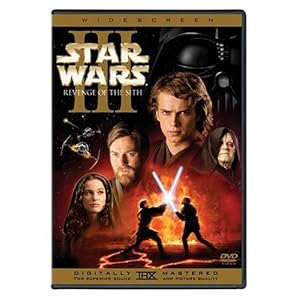
Star Wars Episode III: Revenge of the Sith


For some reason, when it came out, Sith got a decent amount of good press, and I'm not sure why. It's certainly darker and more violent, but that's not exactly what critics go for. It was critical for Anakin's inevitable turning to the dark side to work for the trilogy to be close to redeemable, and unlike a lot of people apparently, I don't think it did. It has to be believable that he'd turn, and making his motivation protecting his wife works. He should have been smart enough to see how he was manipulated, but it's understandable after seeing how emotional and selfish he can be, despite his characterization in Episode I as the nicest little boy in the galaxy.

But the scene of the actual transformation is awful. For one thing, it's somewhat laughable. Palpatine and Windu trying to convince him of the other's wrongness while moaning in their struggle, Palpatine's goofy-ass "No! No!", it's hard to take seriously. And it culminates with Anakin causing Windu's death because killing Palpatine would be wrong, even though he's the guy who made him kill Dooku. Tell me if that makes any sense. Yeah, he really helped Palpatine because he thought he needed him to save Amidala, but it was still a weak scene. Why's he sending the Jedi to arrest him anyway if he needs his help? Did he figure he'd visit him in his cell and learn the secrets of life there?

Besides the botching of the most important scene in the trilogy, Episode III is a combination of enjoyable violence, fan service, and too much post production. For some reason, the sound mix seems a bit off. Like, they rushed through adding the sound effects or something. And the over-reliance on visual effects is ludicrous. It's okay to declare that every clone trooper will be computer generated when they're all helmeted automatons, but when you're superimposing the actor's head onto a fake body, and it's obvious and looks terrible, what's the point? Make a costume, dude. It's fine. A lot of the movie just doesn't go right. Why is McGregor playing such an obnoxious cock now? How could anyone write romantic dialogue this lame? Why are all the robots starting to sound like idiotic children? It's really pretty sad. On one level it's satisfying to see how the world becomes what it was back in 1977, but I just wish it could have been better.

Tuesday, October 21, 2008

Star Wars Episode II: Attack of the Clones


When it came out, I thought Attack of the Clones was better than the first prequel, because I was 15 and it had MORE ACTION. But it's really not true. Is there some rule that people named Hayden have to be bad actors? Panettiere is pretty crappy on Heroes and Christensen is the same here. I hesitate to blame the prequels' badness on him because I honestly don't dislike that guy, but what else can you say when he's the star? I lay most of the blame at Lucas' feet, but a great Anakin could have done a lot of salvaging of the emotional core that makes these movies even close to relevant to the other ones. Without them being the story of Anakin's downfall, they're really just typical brainless science fiction. I'm not sure what I'm trying to say here, really. I've heard that Christensen has been pretty good in other movies, and no one really seems to do their best on a green screen sound stage with Lucas' ability to direct actors being unknown beyond saying "faster and more intense!", so I'll go with my nerd instincts and blame it all on George.

I really don't hate any of these movies that much. Besides The Clone Wars, I mean. I can enjoy a silly movie with entertaining action scenes. And that describes Attack of the Clones pretty well. It's just disappointing to see the heart get slowly sucked out of a beloved series. Making Yoda digital is probably what really got the ball rolling. Yeah, seeing him flip around with a lightsaber like a mad man is hilariously entertaining, but at what cost? Why is doing so many extraneous tumbles through the air anyway. I prefer the old days when the fights weren't quite so elegant but every move had a purpose besides looking neat. Luke was trying to beat Darth Vader, not do the better triple salchow. The overreliance on computer effects is really what gets me more than the silly things that change the series' tone. Besides some background elements, they're rarely convincing, and it just pulls you out of the experience. And as the movies go on, they're pretty much all that's left.

Monday, October 20, 2008

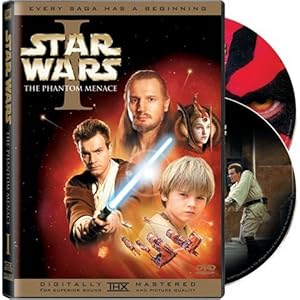
Star Wars Episode I: The Phantom Menace


Episode I confirmed for long-time Star Wars fans what they feared after seeing the Special Editions of their beloved series: George Lucas doesn't know what a good movie is any more. I didn't really notice this when it came out, because I was 12, and I could relate to annoying little kids, and I liked sword fights, especially ones with glowing magic swords. And watching it again now, I don't see it so much as the beginning of the end for Lucas, but a funeral for his good sensibilities. In retrospect, it's the best of the trilogy, and not just because it contains the two best action scenes: the pod race and the fight with Darth Maul. Sure, it introduced many of the things that made the prequels shit on the old movies. Turning Jedi from people naturally attuned to the universe's mysticism into people with a larger infestation of parasites than others was a tragedy. Making everybody know everybody for the sake of cute winks to the audience (Haha, Darth Vader built C-3PO!) is stupid, and just hard to believe when your setting is a galaxy filled with turmoil and not a small town. But it did some things right, before the sequels continued the vicious cycle of more and more visual effects and absurd characterization until we ended up with The Clone Wars, also known as when Star Wars died.

Hell, Yoda's still a puppet in this one. Liam Neeson and Ewan McGregor are two completely likable actors from the British Isles, Natalie Portman is somewhere between cute and gorgeous (Did you know she was born in Israel? Just found this out.), and the three form the nucleus of a decent adventure movie. Yeah, Jar Jar Binks sucks and is mildly racist. Yeah, Jake Lloyd is one of all too many kid actors who piss off grown ups in one or two movies and are never seen again. But the Battle Droids are just soldiers with digitized voices, not an army of fucking clowns. A lot of the sets actually existed in real life. "Duel of the Fates" is probably my favorite piece of Star Wars music. There's still a soul in the production somewhere, and as long as the main characters are good, you have a watchable film. I would not call it a good movie, because as I said earlier, George Lucas forgot what that is. But it's not that bad.

Thursday, September 4, 2008

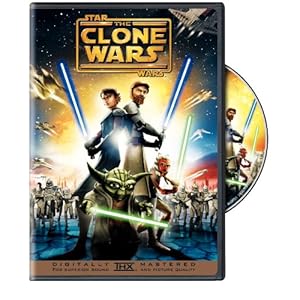
Star Wars: The Clone Wars


I usually don't buy tickets for movies I know will be bad, but I was bored, and I still kinda like Star Wars. Unfortunately, there just isn't much left here of the charm and wonder that makes Star Wars fun. I think the problem with all of the new movies is that George Lucas has too much control. Obviously he should have a lot of say; it's his series and his money that lets it continue. He's had a lot of good ideas in his life. He's also had a lot of fucking stupid ideas too. When they were making the original trilogy, he had friends like Stephen Spielberg helping him keep it on the right track, and the latter two movies weren't even directed by him. But now, he's more or less completely in charge, and nobody's telling him his ideas are fucking stupid anymore. He was still getting some help on the live-action prequels, but at this time all he has left are people that do whatever he says. Case in point: Ziro the Hutt, also known as the worst character ever created. A slimy Hutt cooperator isn't a terrible idea, but making him not only speak English, but sound like Truman Capote too is. If this had just stayed as a bad idea, it wouldn't be an issue. But no one slapped Lucas in the face and said "George, that's a fucking stupid idea. The fact that Hutts clearly understand English (Basic, whatever) since they don't need a translator but still don't speak it obviously suggests there's some reason for this, and you're just throwing that away. Also, Truman Capote? Are you fucking serious?" Instead, they just said "Whatever you say, George!" and went about hiring someone who could do a Capote impression to do the voice and animating Ziro to look like he was saying the lines. This breakdown in the proper course of events is the perfect example of why Star Wars sucks now.

But the movie wasn't just bad because of Ziro, it was generally boring and childish. I realize Star Wars is made with kids in mind, but with that being the case they should at least stop trying to pretend it's for adults too by throwing in all the conspiracy and war stuff. Not that the conspiracy makes any sense. As far as I could grasp from the prequel movies, Palpatine hired Dooku and the Trade Federation to start a separatist movement against the Republic, so the Senate would give him total power over the military, allowing him to use it to take it all over for himself. He and Dooku used another Jedi to commission the Clone Army and then killed him, although you wouldn't know this unless you were a huge Star Wars nerd or looked it up like I just did, because the Jedi in question only warrants a passing mention in the films despite this part being pretty important to the plot making sense. Still, it makes some sense. A convoluted plan, but it works. What doesn't make sense is why Palpatine and Dooku actually seem to care whether their fake droid army does well. Which they clearly do in this movie and probably will throughout the upcoming series that this movie kicks off. The whole plot of the movie is about the bad guys trying to trick the Hutts into thinking the Jedi are out to get them and win their allegiance, giving them a significant advantage in the war. But why are they trying to get an advantage at all? Why did they let this war go on for THREE FUCKING YEARS before calling in Order 66 and killing off the Jedi?

Ignoring the fact that the Clone Wars property is a huge collection of toys, comics, books and tv shows built on nonsense, the movie just isn't that well put together. It really does feel like an extremely long episode of a show instead of a movie, and the entire third act had me waiting for it to end. The action scenes weren't really exciting. We've seen a whole lot of clones and robots shooting at each other, and they haven't figured out how to make a lightsaber duel work yet with this animation style. The cheeky sniping between Anakin and his new, fairly irritating apprentice does nothing for me. Did they really think it would be clever for her to call him Skyguy or something? Also, the battle droid dialogue is getting out of control. They were kind of silly in Episode 1, but at this point you have to wonder why they programmed their soldiers to be retarded. They got a laugh out of me once, when one screamed a mournful "Why?" after an ally threw him off a cliff to his doom, but other than that they were painful to watch. The kids behind me in the theater were laughing it up, though. And I don't really feel the need to take that away from them. What was I expecting, when Lucas himself called putting this in the theaters "almost an afterthought"? He says he's going to produce 100 episodes of the series, regardless of ratings. It's that kind of insanity that makes me respect the guy for just doing what he wants, regardless of his success. I might check out the show when it airs, because there are worse things in the world than a half hour of cartoon violence.

Wednesday, May 7, 2008

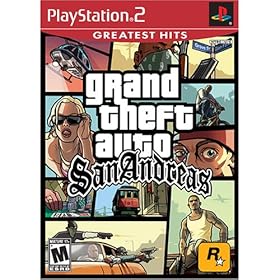
Grand Theft Auto: San Andreas


The third game in the trilogy, and flat-out one of the biggest ever.

With San Andreas, Rockstar full subscribed to the idea that bigger is better. The world is massive. It covers an entire state, containing not only three cities, each bigger than the ones in previous games, but also quite a lot of real estate in between, including forests, a desert, and many small towns. The soundtrack isn't as good as Vice City's, but still included a large variety of enjoyable music. They also improved the streaming technology, allowing you to go from anywhere outside to anywhere else without a single loading screen. It's quite an impressive feat, and really increases the scale of some of the bigger chases you can get into. There's a larger variety of vehicles you can use, including special ones like bicycles, tractors, and jetpacks, and there are many more indoor locations you can explore. The biggest gameplay change was the addition of a variety of role-playing elements, giving you full control over your character. CJ is always the same person in the story, but you can work out to make him buff or eat a lot to make him fat. There are several different clothes stores you can use to change your look (and how people react to you), and multiple girls you can befriend and date, giving you various bonuses for doing so. At the beginning, CJ is pretty bad at driving and shooting, but using the different kinds of vehicles and guns improves his performance with both.

With so much to do, the game could have gotten too big for its own good, but fortunately it didn't. It does an excellent job of balancing everything and easing you into it, keeping you focused on one major issue at a time. What was interesting was the distinct feeling and atmosphere in each of the three cities. The take off of Los Angeles is where everything starts and ends, and is full of the gangland warfare prominent during the time period. A lot of people can't get into that, but I thought they pulled it off pretty well. Taking over territory was an interesting diversion (as long as you didn't do too much of it the first time around, since all of your progress gets erased), and some of the things that happen near the end, like a riot in the city, are handled pretty well. Even if you don't like that culture, there's some more traditional Grand Theft Auto stuff in the other cities, where you tend to deal with other sorts of criminals, like a blind Yakuza in the driving-focused fake San Francisco and Italian Mafia in their version of Las Vegas, which includes a really cool, optional casino subplot.

CJ is a really well-rounded, likable character. He's not as independent as Tommy Vercetti, but he's a more sympathetic guy. The story follows him as he tries to help his family and rebuild his gang's status, while going after a pair of corrupt cops who have wronged him from the start. Some familiar faces show up, and the cinematics felt even more authentic once the developers learned they could get away with cussing. The missions are more elaborate than ever, and the game is filled with great moments, including countless spontaneous ones just screwing around with a friend in co-op. Some people complained that the RPG elements got in the way of the game, but that simply wasn't true, they almost always felt like an enjoyable addition, becoming a hassle on only a few small occasions. San Andreas was as big as it could get, but now it looks like Grand Theft Auto IV will be a more contained, tighter experience.

Sunday, May 4, 2008

Iron Man


I never read any Iron Man comics, so my experience with him is limited to a few appearances in animation and his douchey role in the Civil War novel I read last summer. I was still receptive to the idea of the movie, because if anyone can make an obnoxious billionaire weapons manufacturer sympathetic and likable it's Robert Downey Jr, and you could tell from interviews that Jon Favreau wanted to do it right. While I didn't have much existing knowledge or affection for the characters, it was still a good film, one of the better comic book adaptations in recent memory. I'd place it behind a few others, but it's definitely in the upper level, easily better than the dregs like Fantastic Four.

A big part of the success is the humor. In general, the film is pretty mature and handles itself much better than those worse comic movies, but the characters themselves are quite funny. Downey is the same great comedic presence he always is, and Gwyneth Paltrow, playing his assistant, is also pretty good on some occasions. The story is pretty decent as far as primarily establishing the character and setting, which the first attempts in these comic franchises always end up doing, and the special effects are quite nice. They did as much as they could in-camera, which I always prefer if it's doable. It seems like they always try to shoehorn in a villain that has a parallel to the hero, and the movie gets quite cheesy once the villain fully emerges. The best action scene is the one where Tony does a field test on the completed Mark III armor, with the final battle being decent but a little predictable. What might be most exciting about the film for comic geeks is the tidbit after the credits, which shows Marvel, now financing their own films, working towards integrating their different characters a little bit. It's unfortunate so many of the movies they made suck, because realizing the whole universe in film effectively would be pretty damn cool.

Tuesday, February 5, 2008

Goodfellas


As far as "true stories" go, Goodfellas' is a pretty entertaining one. A little too much of it is narrated, although I'm sure that was less of a complete cliché at the time. It's a winding tale of growing up as part of the mafia, and how instantly things can change or go wrong. Henry Hill grew up envying and eventually joining a family, although he was always on the outside because of his non-Italian blood. The biggest obstacle to his success is Tommy, a guy he came up with who's friendly with him but a little too insanely violent for his own good. Tommy's played expertly by Joe Pesci, who won an Oscar for his efforts. I've seen better acting, but his embodiment of the roll is complete and there are tons of legendary scenes showcasing the real-life personality. Ray Liotta and Bob De Niro are also very good with their parts, more level-headed counterparts to Pesci and apparently very true to the people they mimicked.

I recognized several actors from the little I've seen of The Sopranos, including the therapist, played by Lorraine Bracco, who is also very good as Hill's wife, innocent at first but drawn into the world of crime. The movie as as much about Hill's home life as his work, and the development of their relationship along with his advancement in the ranks make an interesting story. This is one of the multiple occasions where many believe Martin Scorsese was robbed of the Best Director Oscar, which he eventually won with my 2006 movie of the year The Departed, and I can definitely see their argument. The construction of each scene is excellent, with some really great extended shots fleshing out the realistic vibe. There's also artistic handling of key moments, like the subtle perspective shift in an important diner scene late in the film I might not have noticed were it not point out to me, and the whole cast does great work for him. I really should have seen it sooner, but it's never too late to watch a good film.

Friday, August 3, 2007

Television Update 1: Anime Round-Up

I don't really have the energy to be too specific much farther back in time, so I'll just summarize the rest of what I saw in 2007. This is the first half.

Afro Samurai


This was a nice small collaboration between Japan and the US. It was extremely expensive to produce, but the results can be seen in the visuals. It's one of the most stylishly animated things I've ever seen. The action is pretty awesome, whether he's fighting an equal opponent or a large group. It can have some weird diversions, and since I usually watch anime with subtitles, it was odd to hear Sam Jackson's voice coming out of the character. He did okay in the role though, and it's a fun, quick watch.

Ah! My Goddess - Season 1 + Movie + OAV


The OAV and series are basically the same thing. They have different climaxes, but are the same thing, with a lot of shared elements. I preferred the series a bit, because it fleshed out the characters more, and too much of the OAV was spent worrying and waiting for the end. It just got heavy. The series was a little more light-hearted and enjoyable. The show is mildly entertaining, but it can sometimes get dull. It's another Magical Girlfriend show, and she is just a little too obedient and devoted. The guy is a nice enough character, and deserves a good life, but too much of her personality is just serving him. I thought the movie was great. The animation is excellent and story is intriguing. It doesn't quite fit in with the rest of the canon, but it's still quite good.

Gunslinger Girl - Season 1


Definitely a unique series. It's very short and has no actual storyline. There are events, but there's nothing driving it and no climax to come to. It introduces some characters, develops them a little bit, has them shoot at stuff, and then it ends. The animation, especially in some specific action scenes, is great. The premise of young girls without families engineered into super soldiers is an interesting one, and the show touches on some of the issues that would arise. It's hard for me to really dig something so lacking in point, though.

Love Hina + Specials


Another Harem show. It's kinda funny, with some decent characters, bu it gets frustrating with the girl's refusal for the longest time to admit she has feelings for the guy. He has troubles too, but he gets past them sooner. The art direction and all that is fine, and it's definitely a watchable show, considering the very compressed time span I watched it in. It's an extremely prolific show among anime fans, and I guess it's a good example of what this side of the genre is like.

Martian Successor Nadesico + Movie


A fairly influential sci-fi/mech show from the 90's. It didn't have as big of an impact as Neon Genesis Evangelion, which came out about a year earlier, but it was still popular. It can definitely be seen in a lot of newer stuff, though. It's interesting because it's actually willing to kill off characters and allow romance to develop. It's all a little goofy, which can be good or bad depending on what you're really expecting. The movie is a lot more serious. It takes place after the show, introduces a new conflict, and doesn't resolve it beautifully. It ties up some of the things previously left hanging, but the ending is another annoying ambiguous one with some seriously confusing actions taken by principle characters. I'd call Nadesico watchable but not essential.

Ninja Scroll


Now this is a weird series. It follows up the movie, which was a classic, full of violence and awesomeness. The show has some of that violence, but replaces the awesome with strangeness. There's a lot of new villains Jubei faces off against, although they're less interesting than the movie. Unless you count repairing your face with snake skin and replacing your missing limbs with those of a bear as interesting. There are some less than likable secondary characters. A lot of the episodes just have some weird thing happen, and it's all tied together by a loose plot, but it's just a sub-par show. There are some cool moments, but I definitely wouldn't recommend it unless you absolutely love the movie.

Read or Die


A nice, interesting little release. The protagonist is a little annoyingly naive, but she's still interesting and quite capable in a bit of a bumbling way. The animation is superb, with lots of great little touches and smooth movements. The story is strange, with resurrected famous people conducting a plot to kill lots of people, but intriguing. The whole thing is a bit off-beat but very enjoyable.

Rumbling Hearts


Definitely notable from steering clear of genre conventions and being willing to have a sad ending. It starts as a complex love triangle but it's a lot more than that, as tragedy strikes and the characters get older. There's a lot of heartbreak and sadness, and it can be quite depressing. The point is not to glorify relationships, but realistically depict how badly things can go wrong. There is happiness to be found, but it doesn't come without struggles. Besides some annoying comic relief, a well-written, good show.